August week one summary

False image claimed to show rifles seized by Fano militants

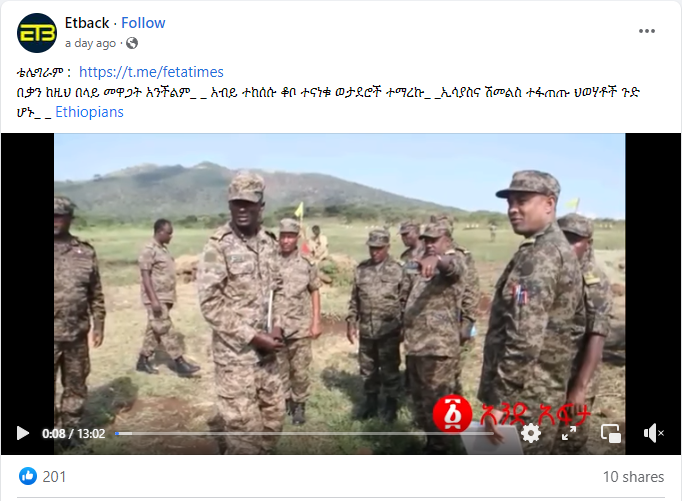
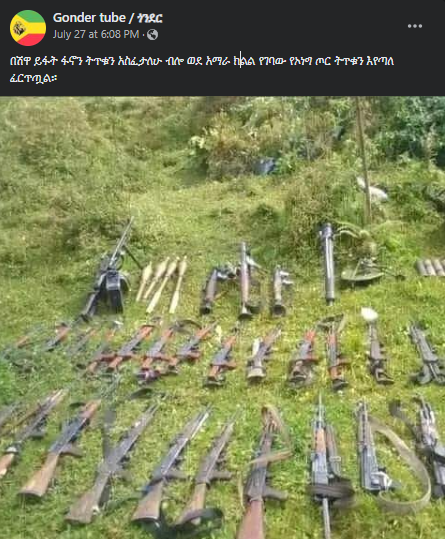
A Facebook post with over 90,000 followers claimed that Ethiopian army troops entered Shewa Yifat in the Amhara regional state to disarm Fano militia groups, but were defeated and retreated, abandoning weapons. The post was accompanied by an image that was falsely claimed to show the rifles seized by the Fano militants.

This image was also published along with similar claims. At the time this article was published, the post had more than a hundred reactions.

The claim came amid intense instability in the Amhara region, where Fano militia groups have been clashing with Ethiopian security forces. Recent social media reports claimed that a conflict broke out in Gondar and several people died as a result.

Recent media reports claim that a conflict broke out in Gondar and several people died as a result. 

Following the incident, other social media posts claimed that the federal government of Ethiopia was deploying troops to places in the Gondar zones. 

There were also media reports that armed militia groups in the region had taken control of some areas, including the Lalibela Airport.

The Ethiopian government this week declared a state of emergency in the Amhara region to reverse the worsening security situation.

However, the image that was used to support the claim about the Fano militants seizing weapons from the Ethiopian army was old and did not show any such event.

False images of militia groups seizing weapons

Following the widespread conflict and armed confrontations between the Ethiopian government and local militia groups in the Amhara region, social media platforms were flooded with claims of military victories.

Some claims were accompanied by old and false images.

One particular example this week was a Facebook post made on Aug 1, 2023, sharing three images with a claim that Fano militants had destroyed Ethiopian military troops and captured weapons.
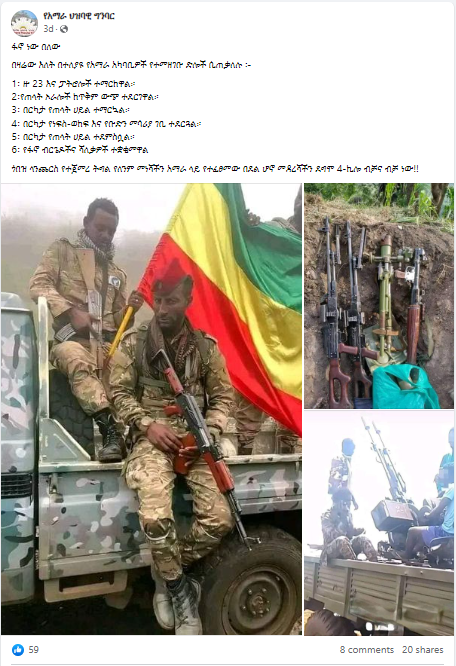
The post was shared 20 times on the platform.

However, two of the three images used to support the claim were old and found published on the Internet several months ago.

The first image in the post was published for the first time on Dec 14, 2022, on Facebook. The second picture was found posted on a news site alongside a news article published on July 2, 2022.

Recommendations

HaqCheck urges social media users to be critical of potentially misleading or false claims. They should verify the information before reacting to claims. They are advised to check the source of the information, look for other sources that corroborate the claim, and be aware of the potential biases of the source.

We recommend that public institutions and government offices provide timely updates to the public and the media. This will help to ensure that people have access to accurate information.

Social media content creators should be responsible and refrain from circulating false and unverified information. They should be aware of the potential impact of their posts on public lives.

July week three summary

In the third week of July 2023, several disinformation and controversial claims circulated on social media platforms regarding the ongoing conflicts in the Amhara region of Ethiopia.

False claim of Fano militants capturing weapons

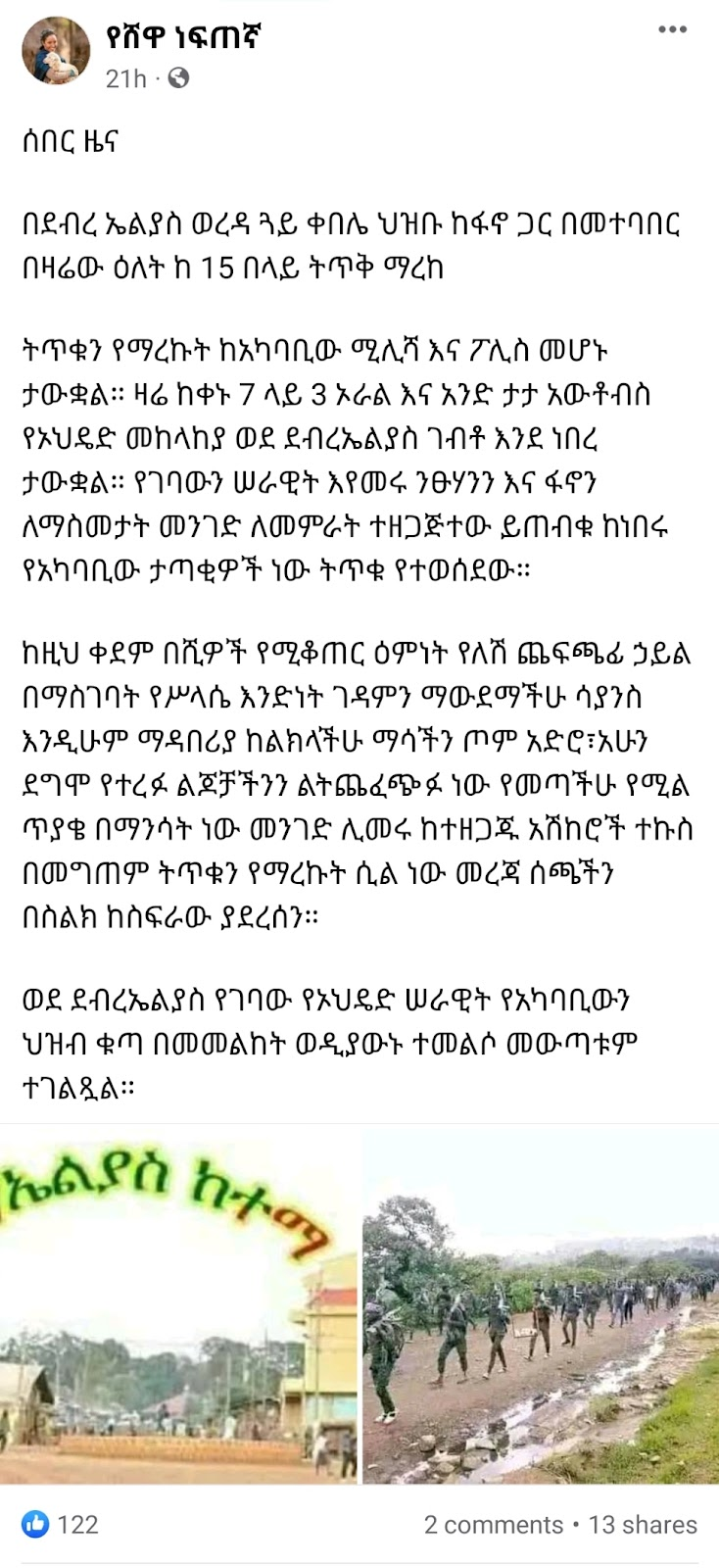
A Facebook post on July 10 claimed that Fano militants in the Debre Elias Woreda seized over 15 rifles from local militiamen and policemen who supported the government. The post further stated that the weapons were confiscated during a confrontation with pro-government forces. 

The Amhara region has been experiencing widespread armed clashes and unrest since recently. Protests erupted in the Amhara region following the Ethiopian federal government’s decision in April 2023 to disarm special police forces. This decision led to conflicts and armed clashes involving the Ethiopian government’s armed forces and informal armed militias in the region. Numerous casualties have been reported in recent armed confrontations.

The Amhara region’s East and West Gojjam zones witnessed conflicts and protests during the reported week. Both sides suffered casualties, with security personnel being responsible for protester deaths, while armed militias killed Ethiopian army soldiers.

Civil unrest occurred in Denbecha, Jiga, and Finote Selam in Gojjam, resulting in three fatalities and over 20 injuries. The clashes involved unidentified armed groups and government security forces. 

However, the claim that Fano militants in the Debre Elias Woreda confiscated over 15 rifles from local militiamen and policemen was rated as false since the accompanying image was outdated and did not support the claim.

Social media reports of fighting in Wollo

Reports of fighting between Fano militants and Ethiopian defense forces (ENDF) in Wollo, particularly in the town of Kobo, circulated widely on social media platforms. 

However, some of these social media posts contained misleading information, including the use of irrelevant images and videos. The proliferation of social media posts about the issue added to the complexity of understanding the actual situation on the ground. 

Recommendations

Social media users should be cautious when encountering instant claims and sensational news on their feeds. Before sharing or reposting such content, it is essential to question its authenticity and consider the source’s credibility. Users must take the time to verify the information from multiple reliable sources before passing it along to their networks. Users should prioritize seeking out original and reliable sources of information. 

Government agencies and institutions should provide timely updates and clarifications to the public and media. Regularly sharing accurate information can help combat the spread of misinformation. Government agencies need to uphold citizens’ right to access information in its entirety.

Social media content creators should prioritize accuracy and reliability when sharing information. They should refrain from participating in the dissemination of disinformation or sensationalized content that can further fuel conflicts and misinformation.

July Week One Summary

UNICEF Job Advertisement Scam

A job advertisement claiming that UNICEF is hiring 2,800 workers in 6 regions of Ethiopia has been circulating widely on social media. The advertisement asks for 100 Birr for the registration application form and urges potential applicants to pay the fee in advance via CBE Birr or Telebir.

Later on, the post was confirmed to be a hoax and did not come from the alleged organization, UNICEF Ethiopia. UNICEF Ethiopia has issued an official statement denouncing the fraudulent job advertisement. According to the organization, such an advertisement does not originate from UNICEF, and it has been falsely circulated. UNICEF asserts that its genuine job advertisements are only posted on the UNICEF Careers website, ensuring transparency and authenticity.

In addition, UNICEF has stated that it does not charge money for the recruitment process and that it does not ask for bank details.

Alleged Creation and Distribution of Improvised Rifle to Fano Militiamen in Amhara Region

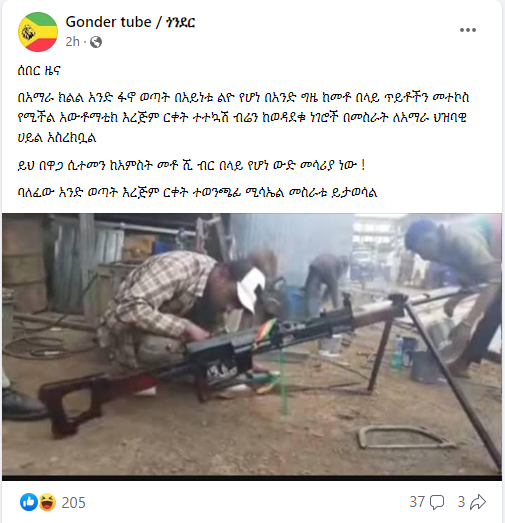
A Facebook post appeared sharing an image with a claim that an individual in the Amhara region has purportedly built an improvised rifle using scrap materials and subsequently distributed it to Fano militiamen. The claim suggests that this weapon has been assembled using rudimentary means and has been supplied to Fano armed groups in the area.

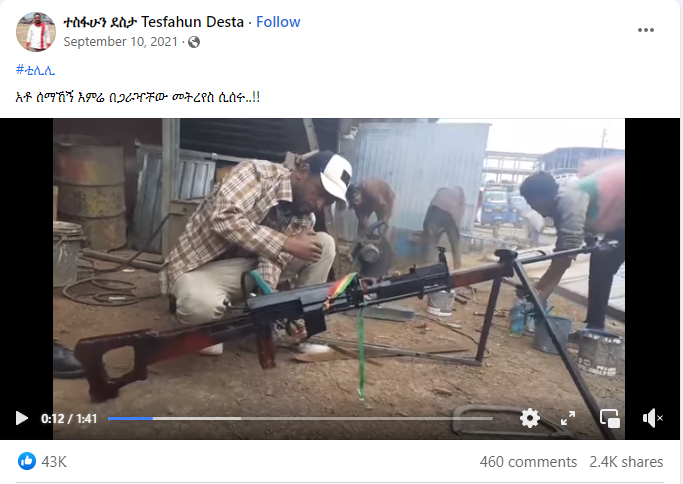
However, through investigation, the origins of the image were traced back to the video from September 2021, which was posted on Facebook.

A False Image of Military Vehicles Belonging to OLA

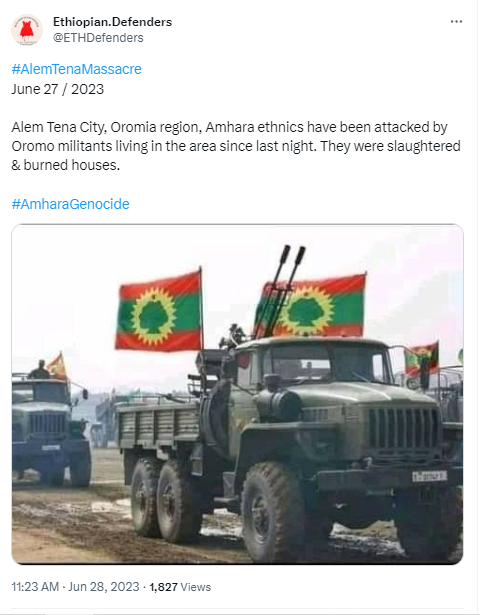
A Twitter post emerged sharing an image with a claim that an ethnic attack occurred in Alem Tena town, Oromia region, where Amhara individuals were targeted and harmed by Oromo militants.

The accompanying image depicts military vehicles with a flag that belongs to both the Oromo Liberation Front (OLF) and the Oromo Liberation Army (OLA).

However, the image was altered and doesn’t support the claim. The original image was published for the first time on Facebook in June 2020. The original image shows military vehicles with Ethiopian flags.

Recommendations

Job seekers should be wary of any job advertisements that ask for money or bank details. Social media users should be aware of such fraudulent activities and rely on authentic sources while seeking employment opportunities.

Social media users must approach instant claims with skepticism and verify their authenticity before sharing them. It is recommended to seek out original and reliable sources of information.

HaqCheck encourages government agencies and other institutions to provide timely updates and clarifications to the public and media. Furthermore, it is important to respect citizens’ right to access information in its entirety.

Content creators on social media should assume responsibility and refrain from participating in the dissemination of disinformation.

June week three information disorder summary

Armed fighting in Gojjam, Amhara

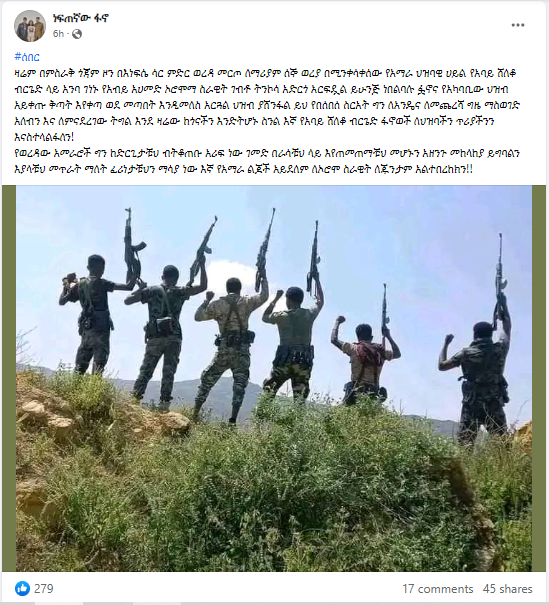
HaqCheck found and investigated an image-backed claim posted on Facebook on June 16, 2023. The Facebook post, sharing a picture, claimed that there was armed fighting between Fano militias and the Ethiopian military troops in Eastern Gojjam, Amhara region.

The viral Facebook claim added that the Ethiopian troops deployed into the area were routed and forced to retreat.

The claim came out against a backdrop of recent armed clashes and protests in the Amhara region.

News reports indicate that there were armed confrontations in East and West Gojjam zones of the region in which protesters were killed by security personnel and armed militias killed Ethiopian army soldiers.

Particularly, after the Ethiopian government began demobilizing regional special police forces, there have been resistance and clashes in the Amhara region. It was followed by widespread protest and armed clashes between the Ethiopian government’s armed forces and informal armed militias.

Additionally, social media claims say that the Ethiopian government has been deploying troops into the Gojjam zones of the region to disarm militant groups.

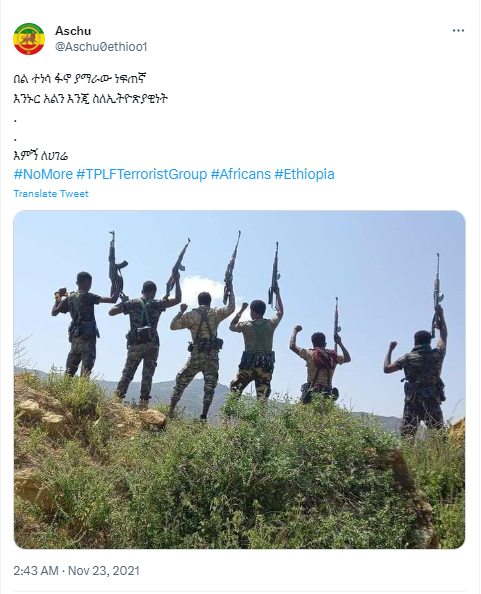
However, the image was old and was published on social media platforms years ago. The picture doesn’t prove the claim.

The image was published for the first time on Twitter on Nov 23, 2021, when Fano militias, alongside the Ethiopian and Eritrean armed forces, were fighting against the Tigray People’s Liberation Front (TPLF) forces. It was shared on the platform in this context.

The same image with opposing claims and competing narratives

On June 10, 2023, Addis Standard, a local news outlet, reported that at least five people were killed and other dozens were wounded in a fresh attack in the Amuru district of the Horo Guduru Wollega, Oromia regional state.

The report stated that residents told that the attack in which properties were destroyed, and houses were burned and looted was perpetrated by Fano militants.

The two Wollega zones of the Oromia regional state have been ridden by recurrent conflicts, horrific acts of violence, and mass displacement. Many people were massacred in various Wollega zones.

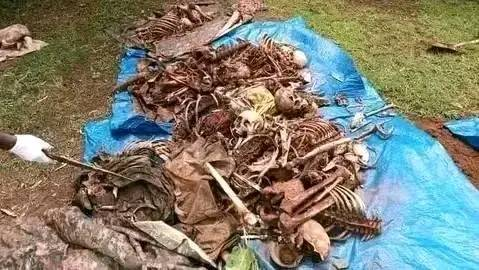
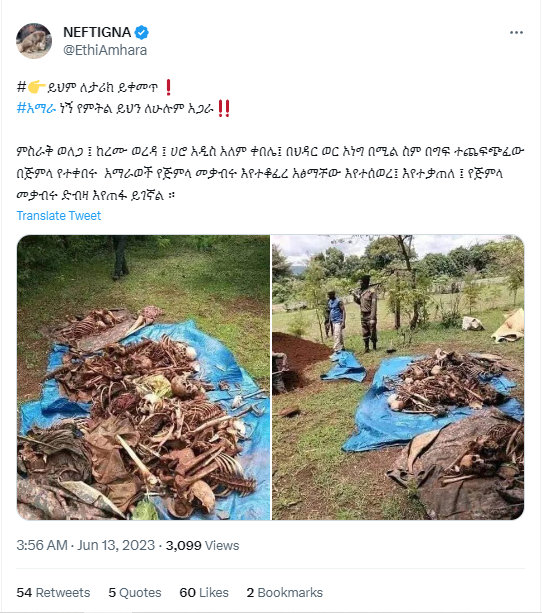
In this context, pictures of bones and skeletons of dead bodies were shared on social media platforms with claims that the remains belong to the victims of the recent attack in Wollega.

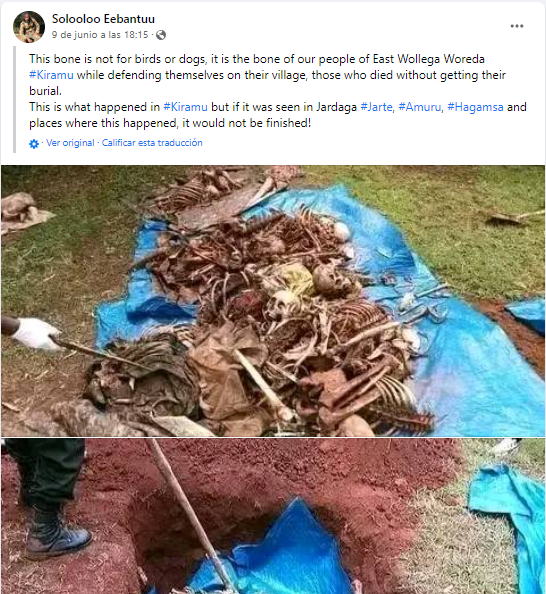
One of the images was shared on Facebook and Twitter with opposing claims (claim and counterclaim).

The image was posted on Facebook on June 9, 2023, with a claim that human remains belong to Oromos who were killed in an attack in the Kiramu Woreda in Wollega.

On June 13, 2023, the same image was shared on Twitter with an opposing claim that the image show corpses of Amhara people who were massacred in the Kiremu Woreda being collected and burned down.

The same image was shared with opposing claims to cement competing narratives in the Ethiopian media landscape. As events happen, conflicts claims and competing narratives usually follow.

Recommendations

HaqCheck recommends social media users be skeptical and exercise caution when they encounter controversial claims and possibly misleading information. They should look for additional sources and information to confirm if the information at hand is authentic. They should always avoid quick reactions to such posts.

The lack of information from government offices adds fuel to the existing disinformation dissemination and toxic media landscape. We urge government offices and other relevant institutions to offer sufficient and up-to-date information and explanations. There should be timely press briefings on a regular basis.

The Ethiopian government and other civil society organizations are also advised to work towards guaranteeing the right of the public access to information.

Social media content creators and influencers should be responsible while sharing media content and avoid circulating misleading or unverified information.

June week two summary

Massacres in the Debre Elias Monastery

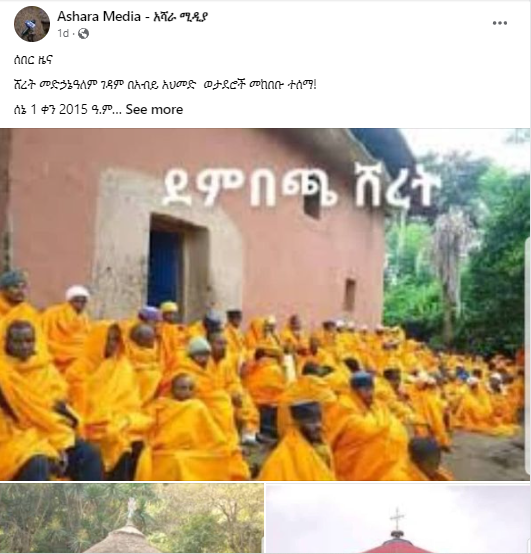
For the last few weeks, social media claims that are related to an armed clash in the Debre Elias woreda in the East Gojam zone of the Amhara region had been circulating. The claims that the government bombarded a monastery in the woreda and killed civilians were accompanied by pictures.

Likewise, similar claims were spotted and debunked by HaqCheck during the second week of June.

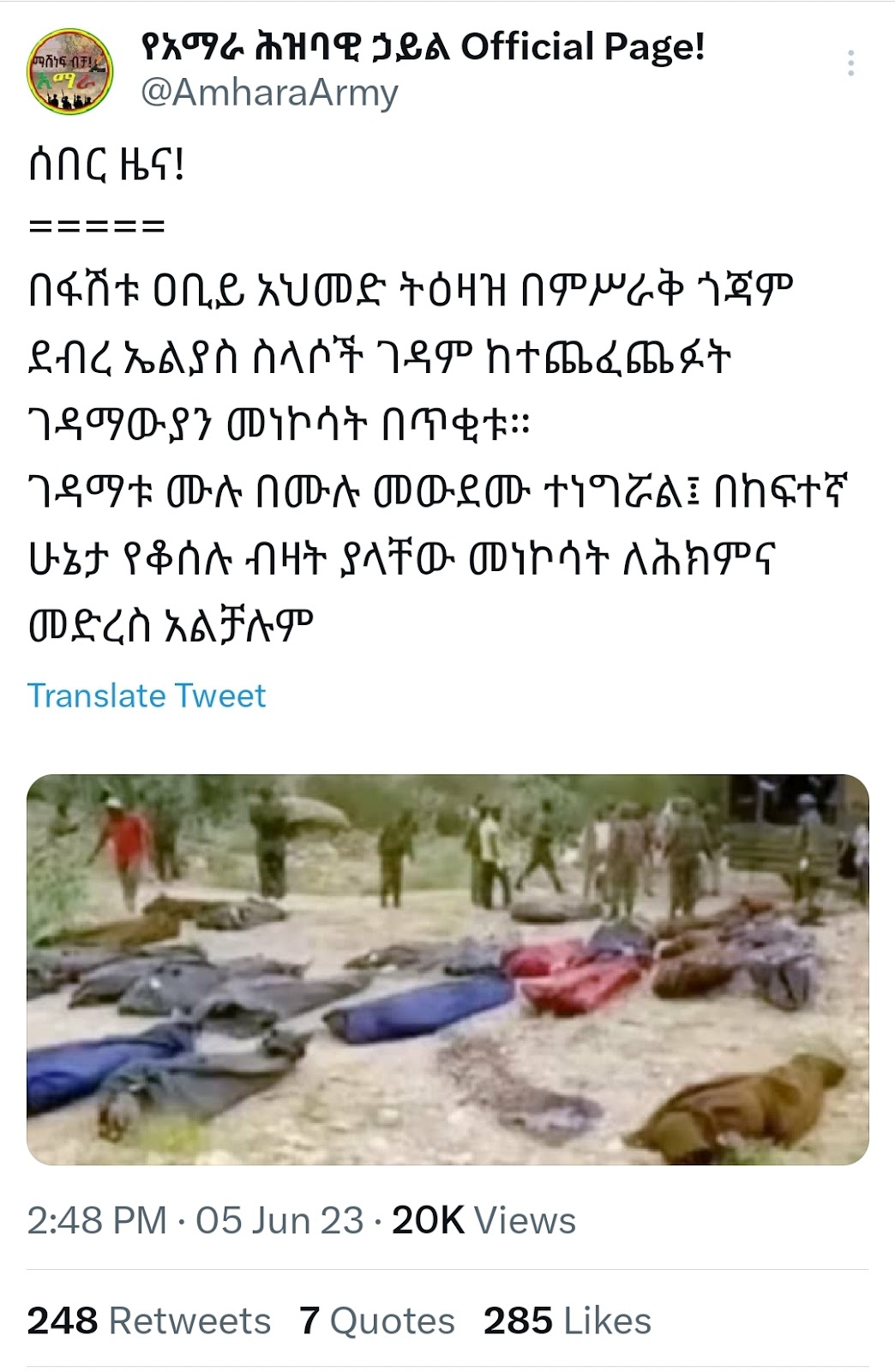
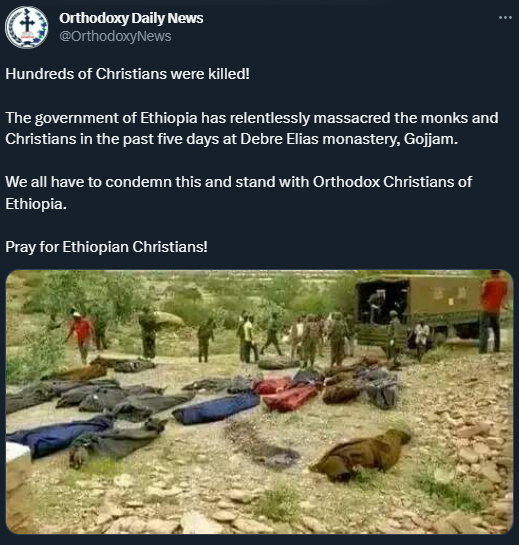
For instance, a particular image was circulating across the Ethiopian social media landscape supporting a claim that the Ethiopian government recently massacred many monks in the monastery in the Amhara regional state.

The image was also shared on Facebook with the same claim that the Ethiopian armed forces were shelling the monastery and killing many civilians.

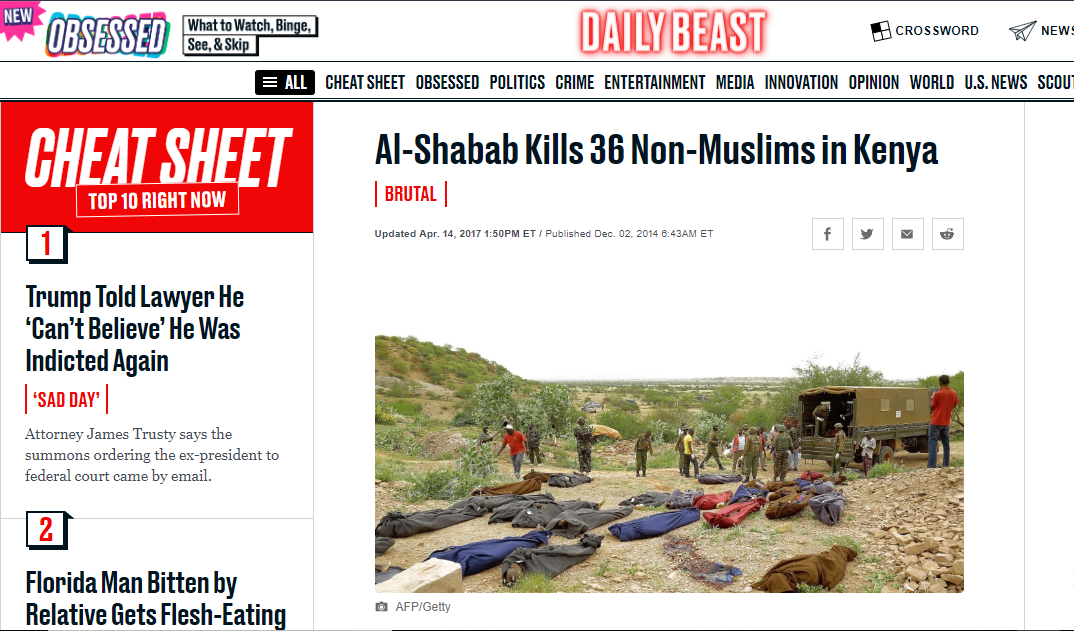
However, the picture was old and found previously published on a news website on Apr 14, 2017.

According to the description of the original image, it shows the dead bodies of 36 non-Muslim civilians massacred by Al Shabaab militants in Kenya.

Ethiopian armed forces besieged a monastery in West Gojjam

Similar to the previous claim in content, the claim that federal armed forces surrounded a monastery located in the West Gojjam zone of the Amhara region planning to attack the monastery emerged at the end of the second week of June.

This claim infested social media platforms and Facebook posts with the same claim were shared over a thousand times.

However, HaqCheck could confirm whether the claim was true or false. Additionally, the images presented alongside the claim were not falsifiable. The pictures only depict monks and chapels.

Recommendations

We recommend social media users be cautious of unverified social media accounts and the information and post that came out of these accounts.

Social media users are advised not to react to controversial claims on social media platforms before are sure that the information at hand is authentic. They should also look for additional information and should avoid hasty reactions.

HaqCheck urges public offices and other institutions to provide the public with timely updates and clarifications.

At last, social media content creators are recommended to be responsible and refrain from disseminating disinformation.

June week one summary

Government forces destroyed a church in Amhara region

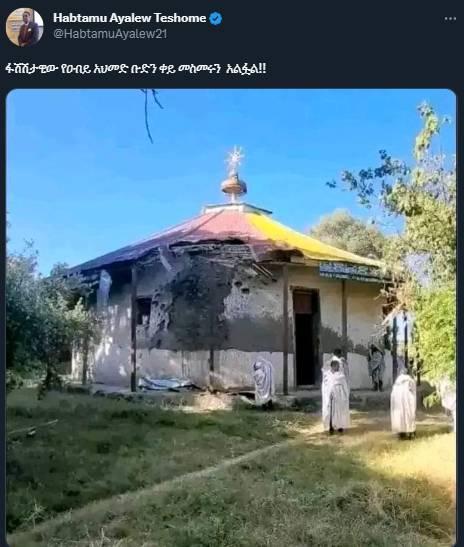
A Twitter account with more than 130 thousand followers shared a post with an image on May 31, captioned, “The fascist group [rule] of Abiy Ahmed has crossed the red line”, indicating that government forces destroyed a church recently. The attached image depicts a damaged chapel building.

However, HaqCheck inspected the image and confirmed the image doesn’t prove the claim.

The image was first shared on Facebook on Nov 30, 2022, with a description that Tigray People’s Liberation Front (TPLF) forces were digging trenches around a church in Kobo, Amhara region.

Hundreds of Christians were killed in a monastery

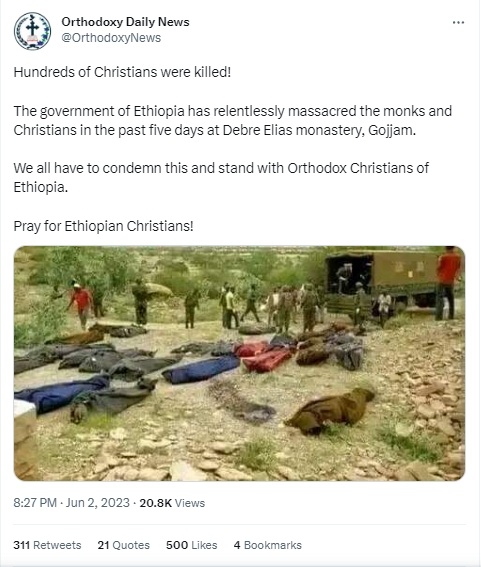
A Twitter post shared an image with a claim that the Ethiopian government massacred hundreds of people in the Debre Elias monastery, East Gojjam, Amhara region.

News reports indicate an armed conflict in a monastery named Debre Elias in the Eastern Gojjam zone of the Amhara region and monks and some other people were killed in the clash.

However, the image has no connection with the claim. The picture is old.

The original image was published on a news site in December 2014 and shows the dead bodies of 36 people killed by Al-Shabab in Kenya.

Recommendations

We urge social media users to be skeptical about instant social media claims. They should try to verify if the information is authentic before they share it with others. They are advised to look for original sources of information.

HaqCheck urges governmental offices and other institutions to offer the public and the media updates and clarifications on a timely basis. Additionally, the right of citizens to access information should be respected to its fullest.

Social media content creators should be responsible and avoid being collaborators in disinformation dissemination.

May week three summary

Houses demolished for the construction of the new Ethiopian Palace

On May 19, 2023, a claim appeared on Twitter sharing two images that they show houses recently demolished for the construction of the new Ethiopian palace in Addis Ababa.

The Ethiopian government is building a new palace in the Yeka district of Addis Ababa for hundreds of billions of Birr.

There were recent social media reports claiming that people have been told to evacuate the area where the palace is being built within a few days.

HaqCheck inquired about the claim and looked into the images used as supportive.

However, one of the two pictures was old and had no connection with the construction of the new palace.

It was first published on Facebook on Feb 19, 2019, with a description that houses were being razed in the Legetafo Legedadi city administration, part of the then Finfinne Special Zone of the Oromia regional state.

The second picture was first published by Addis Standard on Jan 6, 2023, with a description that the picture shows a recently demolished house.

Therefore, the claim was rated Partly False.

Elon Musk launched the production of robot wives

HaqCheck came across many posts in the Ethiopian social media landscape claiming that the American billionaire Elon Musk has begun the production of robot wives and the product would soon be available in the market.

Images that show Elon Musk hugging and dancing with a human-like robot were circulated across social media platforms.

Tesla, an American technology company founded by Elon Musk announced in October last year that it already launched the production of humanoid robots with the purpose that they can help humans in their daily activities. The robots are two models named Optimus and Catanella.

It was in this context the claim came to life. However, the pictures circulated on social media to prove the claim were false and generated using artificial intelligence tools.

Recommendations

Recently, many artificial intelligence tools and software are emerging that can generate that seem very real.

HaqCheck recommends social media users look at images with caution and suspicion in case they are AI-generated.

We advise government institutions and other organizations to be accessible for information inquiries. They should provide timely briefings and updates.

Unfettered access to information is the key to combating disinformation. Access to information should be ensured by the government and relevant bodies.

Social media content creators should be responsible and avoid circulating false information.

 May week two information disorder summary

The Ethiopian government released an AI-fabricated audio

HaqCheck was encountered with viral social media posts that claim that the phone call conversation between Mihret Wedajo and a Fano member released by the Ethiopian government to prove that Fano militias assassinated Girma Yeshitla was examined and debunked by an American organization called ‘Digi Forensic Experts’ as an AI constructed audio.

The claim emerged after the government blamed the Fano militia for murdering the Amhara Prosperity Party head Girma Yeshitla and released an audio that claimed to be a phone call conversation between the militia group’s leader Mihret Wedajo, and Belete Shegaw, a member of the militant group.

Screenshots of the result of the claimed audio forensic investigation circulated across social media platforms.

However, HaqCheck couldn’t find any organizational entity on the Internet registered as ‘Digi Forensic Experts’ and the alleged investigation of the audio released by the Ethiopian government couldn’t be found.

Additionally, the call number given on the screenshots belongs to a company named Digital Forensic Experts and the postal code, street address, and suite address belong to another film company. The text and the images are blurred.

Amharic is the second most-spoken language in the world

A claim was made on Twitter in the second week of May alleging that Amharic is the second most-spoken language in the world after Arabic.

HaqCheck used statistical data from Ethnologue, an annual statistics publication that is one of the top sources of world language statistics, to cross-check the claim.

Therefore, it was found out that Amharic is not the world’s second most-spoken language.

In terms of native speakers, Chinese Mandarin is the first, Spanish is the second, and English is the third.

Regarding total speakers, English is the first, Chinese Mandarin the second, and Hindi the third.

However, according to the publication, Amharic is the second most-spoken Semitic language next to Arabic although research say that Amharic is a mixture of Kushitic and Semitic languages.

Recommendations

 HaqCheck advises that social media users should be cautious of posts that may not be factual or truthful. Before reacting and sharing social media content with others, they should try to verify their authenticity.

To ensure that the public and media have timely briefings and updates, it is requested that public authorities and other bodies make information available and easily accessible.

It should be ensured that access to information is guaranteed. The absence of reliable information causes a much higher incidence of the dissemination of incorrect information.

We recommend that creators of social media content be responsible and avoid contributing to the dissemination of disinformation.

Is the alleged Mihret Wodajo phone call recording audio released by the government AI-generated and Fake?

Social media platforms particularly Facebook recently surfaced with a claim that the phone call conversation between Mihret Wedajo and a Fano member released by the Ethiopian government to prove that Girma Yeshitla was assassinated by Fano militias was examined and debunked by an American organization called ‘Digi Forensic Experts’ as an AI constructed audio.

Background

Girma Yeshitla, the head of the Amhara Prosperity Party, a branch of the Ethiopian Prosperity Party and a ruling party in the Amhara regional state, was killed on Apr 27, 2023, in the Semen Shewa zone of the region.

The federal government accused ‘extremist forces’ of assassinating Girma Yeshitla. It said that these ‘extremist forces claimed to be fighting for the Ahmara people and in reality were trying to capture state power using force’.

The Amhara regional government blamed the Fano armed group, a group of armed militias in eastern parts of the Amhara regional state for the killing of Girma Yeshitila.

The militia group that was accused of murdering the senior party official is led by a person named Mihret Wedajo.

On Apr 29, 2023, state-affiliated media outlets such as the Addis Media Network came up with audio that claimed to be a phone call conversation between the militia group’s leader Mihret Wedajo, and Belete Shegaw, a member of the militant group. 

The government released the audio as evidence that Girma Yeshitla was killed by the Fano militia group.

The audio recording allegedly indicating Mihret Wedajo and another militant confirming they killed Girma Yeshitla had infested the Ethiopian social media landscape.

Days later, on May 7, 2023, a claim circulated across social media platforms that the audio released by the government as a conversation between Mihret Wedajo and Belete Shegaw was proven fabricated and fake.

The social media posts claimed that the audio was examined by an American technology company named Digi Forensic Experts and confirmed as the audio was generated using artificial intelligence.

The social media posts include screenshot papers allegedly taken from the forensic examiner organization. The claimed article was also published on a blog.

HaqCheck endeavored to cross-check the claim.

Is the organization ‘Digi Forensic Experts’ real?

HaqCheck couldn’t find any organizational entity on the Internet registered as ‘Digi Forensic Experts’.

But, there is a company called Digital Forensic Experts. The website of the company claims that it investigates the authenticity of audio and video files.

However, the alleged investigation of the audio released by the Ethiopian government was not on the website of Digital Forensic Experts.

We have searched the social media accounts of the company if the alleged article was published there. But, there was no social media handle with the same name as the company.

HaqCheck looked into the alleged (Digi Forensic Experts) organization’s address on the screenshots. The call number given belongs to a company named Digital Forensic Experts and the postal code, street address, and suite address belong to Kaufmann Media Group, a film company based in California, USA. Digital Forensic Experts and Kaufmann Media Group were founded by the same person named Sam Kaufmann.

Additionally, HaqCheck looked into the screenshot document and the images there. The text and the images are blurred.

[Image taken from the alleged forensic investigation by ‘Digi Forensic Experts’.]

The blurriness of the images and the texts clues that there is a probability that the images and the texts could be altered.

HaqCheck also found similar images on other sites to those used in the alleged forensic examination article.

These images are very similar to the pictures in the screenshots. These pictures were obtained published in a blog along with an article about an audio music forensic analysis.

HaqCheck approached the film production company, Digital Forensic Experts via email to inquire about the case. However, they did not yet respond to our inquest until this article was published.

May week one summary

A person attacked by Wahabis in Ethiopia

HaqCheck came across a Facebook post sharing a picture with a claim that a person shown in the image was attacked by Wahabis in Ethiopia. It also claimed that Wahabis attacked and killed Sufis and Muslims who followed other Islamic sects.

Wahhabi is an adherent of the Islamic reform movement (Wahhabism) founded by Muhammad ibn Abd al-Wahhab in the 18th century in Najd, Saudi Arabia. The adherents of Wahhabism usually call themselves Salafis.

HaqCheck investigated the image to determine the authenticity of the claim. However, the image was taken from an old publication and has no connection with the claim.

The image was first published on a website called Ketto, an online fundraising platform to support health treatment a year ago. The original image allegedly shows a 22 years old adult who had an accident.

Thus, the Facebook claim was rated False.

Altered image of Pastor Binyam Shitaye

An altered image was shared on TikTok claiming that Pastor Binyam Shitaye was seen praying with Muslims. The image shows a man wearing Jalabiya and a Muslim skullcap sitting among other prayers.

Pastor Binyam Shitaye was arrested in February this year in relation to the controversy within the Ethiopian Orthodox Tehahedo Church. The pastor, who is a Protestant and who was supporting the unity of the Orthodox Church, was then released on a 5000 Birr bail.

However, the image was altered. The original picture shows Ustaz Abubeker Ahmed, a known Muslim teacher, and activist who previously was arrested by the Ethiopian government.

The Ethiopian government carried out aerial bombardment in Amhara

An image was shared on Facebook showing the dead bodies of cattle with a claim that the animals were burned and dead due to an air strike the Ethiopian government recently carried out in Amhara regional state.

HaqCheck cross-checked the image and confirmed that the picture doesn’t support the claim.

The image was previously published on Facebook with a description that a fire accident in Gamo zone, southwestern Ethiopia caused damage to animals and property.

Ethiopian army routed in the Amhara region

An image emerged on Twitter supporting a viral claim that the Ethiopian army was being confronted by rebel armed groups in the Amhara regional state and forced to retreat disorderly.

The claim came amid an alleged conflict in the regional state between government armed forces and armed militia groups.

However, the image was old and was taken from a publication made three years ago. The original image shows Ethiopian army soldiers being deployed to battlefronts during the war between the Ethiopian government and the Tigray People’s Liberation Front (TPLF).

Recommendations

HaqCheck recommends social media users be skeptical of potentially false and misleading posts. They should seek to confirm the authenticity of social media content before reacting and sharing it with others.

Public offices and other institutions are urged to offer the public and the media timely briefings and updates.

The right to access information should be guaranteed. Lack of sufficing information greatly prompts the circulation of false information.

We advise social media content creators to be responsible and avoid being collaborators in disinformation dissemination.

Exit mobile version