Misleading debt-to-GDP ratio comparison by Mamo Mihretu
HaqCheck came across a misleading claim by Mamo Mihretu, the Governor of the National Bank of Ethiopia. He claimed that Ethiopia’s external debt stock is very small in comparison to other countries’ external debt stocks such as Kenya, Sudan, and South Africa.
Mamo claimed that while Ethiopia’s external debt is only 24% of its GDP, Kenya, South Africa, and Sudan respectively have debt amounting to 70%, 70%, and 181% of their GDP.
HaqCheck investigated the claim by the National Bank Governor if the figures were correct.
However, HaqCheck confirmed that the claim was false and the external debt-to-GDP comparison was misleading.
Accordingly, the external debt-to-GDP ratio of Kenya, South Africa, and Sudan is respectively 33.7%, 39.6%, and 150%.
Controversies over the dissolution of special police forces
One of the controversies during the week was regarding the dissolution of regional special police forces.
The federal government announced that the establishment of regional paramilitary forces, the special police force, is unconstitutional and regional special police forces should be disestablished.
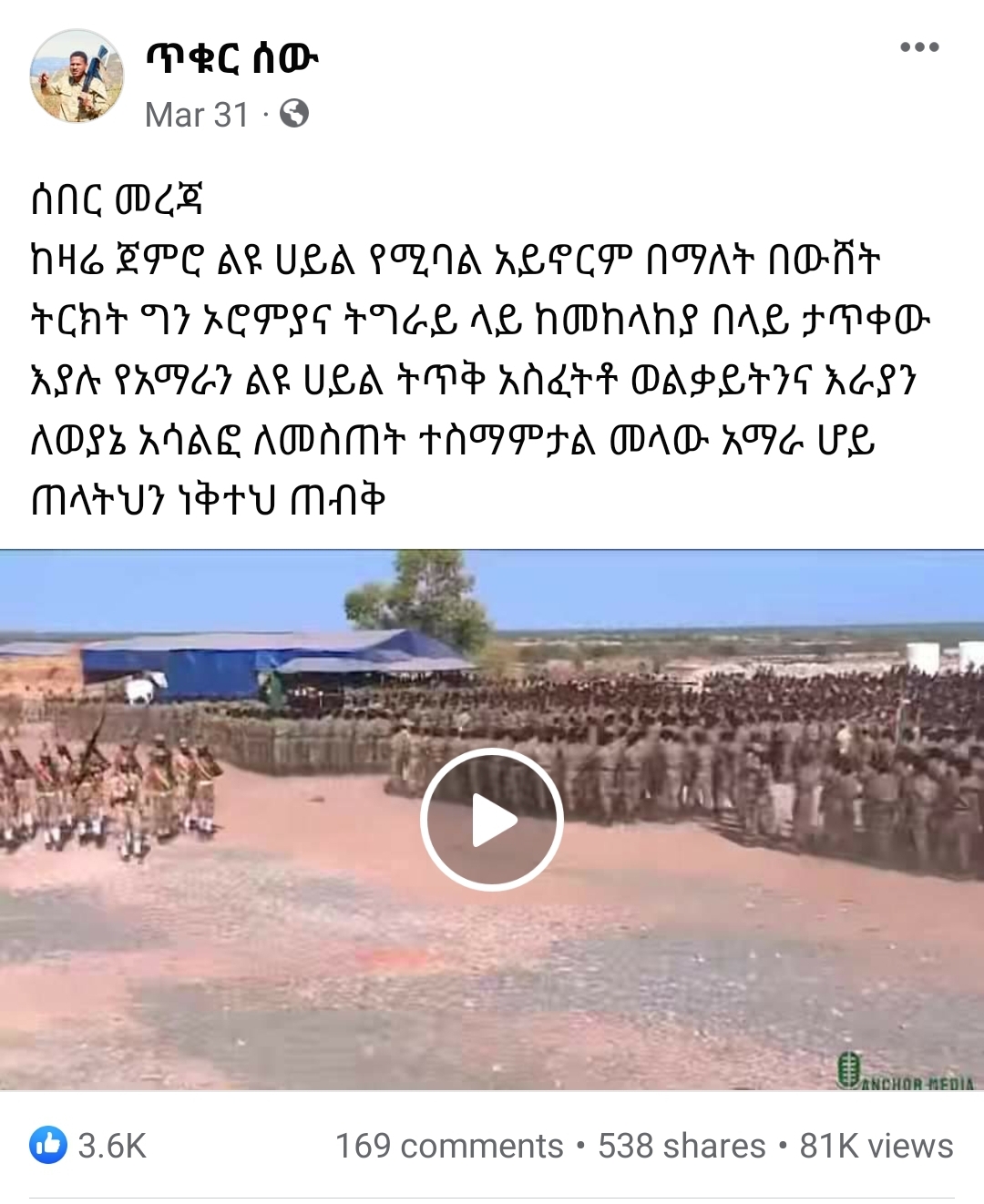
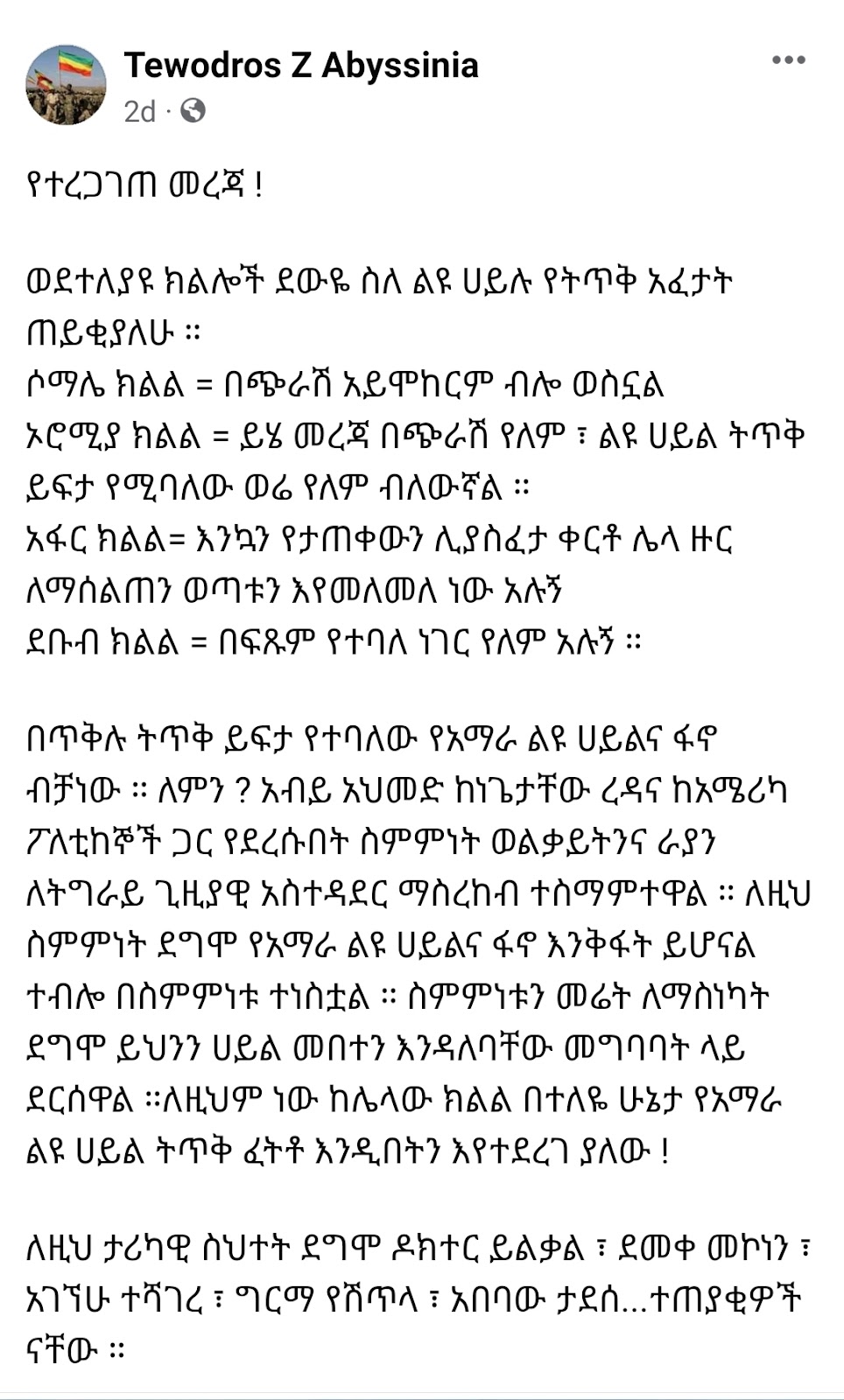
There were claims that the federal government was planning to disarm and disband particularly the Amhara special police force.
Additionally, claims emerged that other regional special police forces would not be disarmed and the government targeted only the Amhara special force to dissolve.
This raised controversy on media platforms and instability in the Amhara regional state.
The federal government, later on, issued a statement and said that regional special police forces were not going to be disarmed and disbanded. It stated that all regional paramilitary forces were going to be reintegrated into the Ethiopian National Defence Forces, into the Federal Police, or regional police forces.
However, controversies and protests, especially in the Amhara regional state continued.
Recommendations
HaqCheck urges social media users to be skeptical of potentially misleading or false claims. They should seek more information from the source before reacting to claims.
We recommend public institutions and government offices offer the public and the media timely updates. The media should also enjoy the right to full access to information.
Social media content creators should be responsible and refrain from circulating unverified information.
Mamo Mihretu, the Governor of the Ethiopian National Bank, in an interview with Fana Broadcasting Corporation Television aired on April 1, 2023, claimed that Ethiopia’s external debt stock is very small in comparison to other countries’ external debt stocks such as Kenya, Sudan, and South Africa.
He said “Ethiopia’s external debt is 28 billion USD. This is only 24% of the [Ethiopian] GDP. This is not a large amount [in comparison with other countries]. For instance, Kenya’s debt amounts to 70% of its GDP, South Africa’s is 70% of its GDP, Sudan’s is 181% of its GDP, and USA’s is over 115% of GDP.”
HaqCheck investigated the claim by the central bank governor, Mamo Mihretu.
The debt-to-GDP ratio or percentage of debt (external, domestic, or total) to GDP is obtained by dividing the debt by the GDP.
Is Ethiopia’s external debt 24% of the GDP?
Yes, it is 24.6% of the GDP.
According to the World Bank, Ethiopia’s GDP at the end of June 2021 was 111.27 billion US dollars.
The annual report of the 2021/22 fiscal year by the National Bank of Ethiopia indicates that Ethiopia’s GDP stood at 5.9 trillion Birr.
The Ethiopian National Bank in its 2021/22 fiscal year report stated that Ethiopia’s external public debt reached USD 27.9 billion which is 24.6% of the GDP [around 113.5 billion USD].
Is Kenya’s external debt 70% of its GDP?
No. It is 33.7% of its GDP.
The World Bank said that Kenya’s GDP at the end of June 2021 was 110.35 billion US dollars.
At the end of June 2021, Kenya’s external public debt was 4,290.7 billion Kenyan Shillings (39 billion USD, calculated using the average exchange rate), which is 50% of the country’s total public debt, according to the Central Bank of Kenya.
Recent reports indicate Kenya’s external debt amounts to 37.87 billion US dollars.
As of June 2022, the external debt of Kenya was 33.7% of its GDP, according to the National Treasury of Kenya. The country’s total public debt is 8.6 trillion Kenyan Shillings which is 67.3% of the GDP.
Thus, Kenya’s external debt does not amount to 70% of its GDP. Rather it is 33.7% of the GDP.
Is South Africa’s external debt 70% of its GDP?
No, it is 39.28% to 40% of the GDP.
South Africa’s external debt stood at 164.6 billion US dollars as of December 2022, according to the South African Reserve Bank, the country’s central bank.
There is no official data from the country’s government on the size of the South Africa’s GDP.
The World Bank and the International Monetary Fund (IMF) present two different figures regarding the South African GDP.
The World Bank says South Africa’s GDP was 419.02 billion US dollars in 2021.
The IMF stated that the GDP of South Africa was 411.48 billion US dollars in 2022.
The average between the figures from the World Bank and the IMF is 415.25 billion US dollars.
Thus, the external debt-to-GDP ratio is 39.6% if we calculate it using the average figure.
If we use both figures of the South African GDP, the percentage of the country’s external debt to its GDP is between 39.28 and 40%.
Is Sudan’s external debt 181% of its GDP?
No, it is 150% of the GDP.
The government of Sudan has not published any latest data regarding the country’s size of GDP.
The World Bank said that Sudan’s GDP in 2021 was 34.33 billion US dollars. But the data is old and we can’t use it in calculating the currency external debt-to-GDP ratio.
Sudan’s external debt has reached 64.16 billion US dollars as of June 2022, according to the Central Bank of Sudan.
Therefore, Sudan’s external debt is 150% of its GDP.
The governor of the National Bank of Ethiopia, Mamo Mihretu, MISLEADINGLY compared the external public debt of Ethiopia to the total public debt (domestic+external) of Kenya, South Africa, and Sudan.
PM Abiy Ahmed (PhD) told the parliament on March 28, 2023, that the rising interest rate in the US has had devastating effects on the Ethiopian economy.
Ethiopia has a lot of debt owed to China and international multilateral lenders. Reports indicate that the country has 56 billion dollars in total debt to be paid. Out of the 56 billion, 28 billion were borrowed from external lenders.
The US and international financial institutions such as the World Bank and IMF pledged to provide Ethiopia with billions of dollars for the Homegrown Economic Reform’ initiated by PM Abiy to liberalise and privatise the Ethiopian economy.
The IMF and World Bank promised to give Ethiopia billions of dollars for the Homegrown Economic Reform.
Later on, these pledges were suspended. The World Bank and IMF suspended the disbursement of the pledged billions of dollars after Ethiopia began filling the Great Ethiopian Renaissance Dam (GERD) in June 2020 and due to the armed conflict in northern Ethiopia.
Ethiopia has since been barred from accessing financial provision from these multilateral financial institutions.
The US government halted hundreds of millions of dollars of budgetary support to Ethiopia in 2020 due to the GERD crisis. Additionally, Ethiopia has been excluded from the African Growth and Opportunity Act (AGOA) trade preference programme because of the war with the TPLF.
Since the wake of the COVID-19 lockdown, countries across the globe have been hit with inflation, mainly due to a shortage of supply (production) because people were off work.
The central banks of many countries have been increasing interest rates to reduce the circulation of money in the market so that inflation could be lowered. The US central bank, the Federal Reserve, has increased interest rates many times since 2022 to bring down inflation to 2%.
In 2022 alone, the US Federal Reserve increased interest rates seven times, raising them from 0.25% in March to 4.50% in December. On March 22, 2023, the Fed raised the interest rate to 4.9%, which is the highest since 2007.
Two weeks ago, the European Central Bank increased the interest rate benchmark to 3%, which is the highest since 2008.
The United Kingdom’s central bank, the Bank of England, raised the interest rate on March 23, 2023, to 4.25%.
Interest rates, particularly in the US and Europe, were very low before the outbreak of the COVID-19 pandemic. Money was cheap and accessible for borrowers.
The high interest rates in the US and Europe mean that countries like Ethiopia have to borrow dollars or other hard currencies at high interest rates to pay back their debts.
The Ethiopian economy has suffered from a shortage of hard currency. This resulted in sweeping inflation and an economic crisis. The government is desperately seeking foreign loans and financial support.
In addition to getting finances, the Ethiopian government has to deal with the staggering amount of matured debt in the country owed to China and international multilateral creditors.
The Ethiopian government has been asking multilateral and bilateral lenders to restructure the country’s debt. Ethiopia requested the G20 countries and the Paris Club, a group of major creditor countries, make debt adjustments.
Upon Ethiopia’s request, in September 2021, twelve member countries of the G20 and the Paris Club formed a committee co-chaired by China and France to discuss the country’s debt treatment.
Ethiopian Prime Minister Abiy paid a visit to France on Feb 8, 2023, and discussed with Emmanuel Macron, French President about the restructuring of debt.
On Feb 20, 2023, an Ethiopian government delegation that includes Finance Minister Ahmed Shide, Mamo Mihretu, Governor of National Bank of Ethiopia, Lelise Nami, Ethiopian Investment Commissioner, Eyob Tekalegn (PhD), Finance State Minister arrived in China to discuss about debt restructuring, among other things, with Chinese officials.
Since the interest rates are high, it is difficult for developing countries, especially those with huge amounts of matured debt, to easily borrow dollars and pay their debts. Money is only available at high interest rates.
Christian Tadele received 74 million Birr via his CBE account
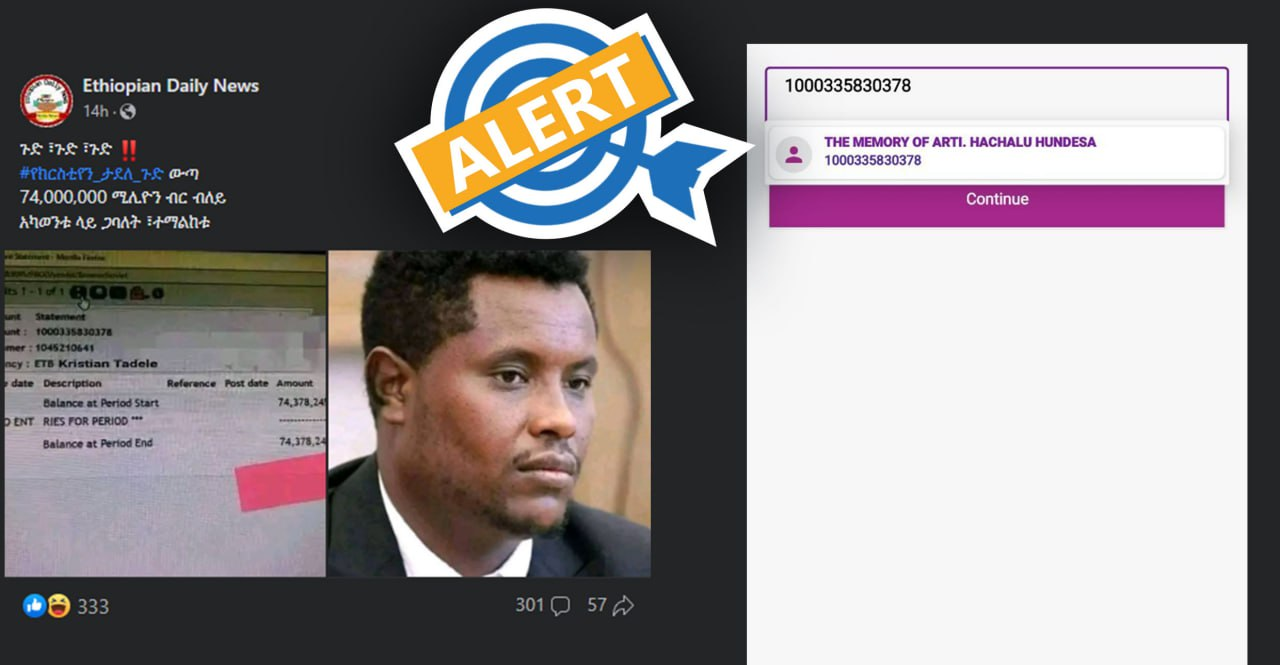
On March 22, 2015, a Facebook page with more than 136,000 followers posted a screenshot image claiming that Christian Tadele, the public relations head of the National Movement of Amhara (NAMA) and a member of the Ethiopian House of People’s Representatives, received 74 million birr through his bank account opened at the Commercial Bank of Ethiopia.
The post shared a Commercial Bank of Ethiopia account number, alleging that the account belongs to Christian Tadele.
The Facebook post was viral and has received over 300 reactions and has been shared over 50 times.
HaqCheck, however, confirmed that the bank account does not belong to the claimed person and was opened in the name of “The Memory of Artist Hachalu Hundesa.”
False donation collection SMS platform
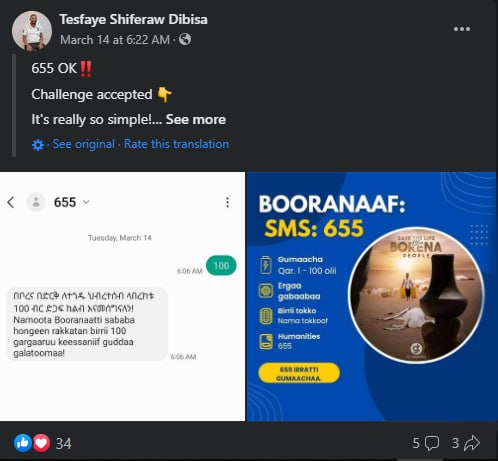
On March 14, 2015, a Facebook page with more than 12,000 followers posted an SMS number, claiming that donations were being collected for people affected by the drought in Borana through text messaging using the number 655.
The post stated that the initiative was started by Oromo artists, that the number for the donation collection was obtained from Ethio Telecom, and asked others to join the donation campaign.
HaqCheck called the customer service centre of Ethio Telecom to investigate the issue. Hence, Ethio Telecom confirmed that no donation is currently being collected via the SMS number.
A satirically altered image of a Bereket Adera
A Facebook page shared a satirical post claiming that Bereket Adera, a young woman investor, was pictured reading the third “Medemer” book of PM Abiy Ahmed while being turned upside down.
Following PM Abiy Ahmed’s launch of his book titled “Medemer”, the Oromia regional government invited investors and prepared a sales and promotion programme for the book. Bereket Adera attended the programme in which purchases of more than 609 million Birr were made.
There were also claims on social media that the woman investor bought the book for 50,000 euros.
However, the picture was altered and made up by composing various images. HaqCheck found the original image published on the Internet.
Even if the post was satire, such posts have the tendency to mislead many people.
Recommendations
Social media users are advised to exercise caution while viewing possibly fraudulent and untrue posts. Before responding to claims and posts, they ought to seek out more information sources.
HaqCheck urges governmental institutions and other relevant parties to provide updates and clarifications on a timely basis.
We encourage social media content creators to be responsible and refrain from spreading inaccurate or misleading information.
The availability of sufficient information is crucial in the fight against misinformation. Disinformation spreads widely as a result of a lack of information. The government and other organisations should protect the public’s and the media’s right to access information.
HaqCheck came across a Facebook post sharing two images with a claim that Eritrean troops were destroying forests in Adiyabo, a locality in the northwestern zone of Tigray bordered by Eritrea.
The Eritrea Defence Forces, Amhara regional militia, and other armed forces were involved in the war alongside the federal government of Ethiopia against TPLF forces.
The TPLF authorities and media outlets had accused Eritrean troops of atrocities and looting.
Eritrean troops withdrew from major towns in the Tigray regional state and pooled into the border areas after the Ethiopian government and the TPLF signed the peace treaty.
Nonetheless, the TPLF authorities recently stated that Eritrean troops were still in the regional state of Tigray and didn’t fully withdraw.
The claim that Eritrean soldiers were destroying forests in Tigray appeared amid this backdrop.
Yet, the images don’t prove the claim. The first image was posted on March 26, 2019, by Deutsche Welle (DW).
The second picture was published by the BBC News Tigrinya on Mar 27, 2021.
Impersonation of government officials
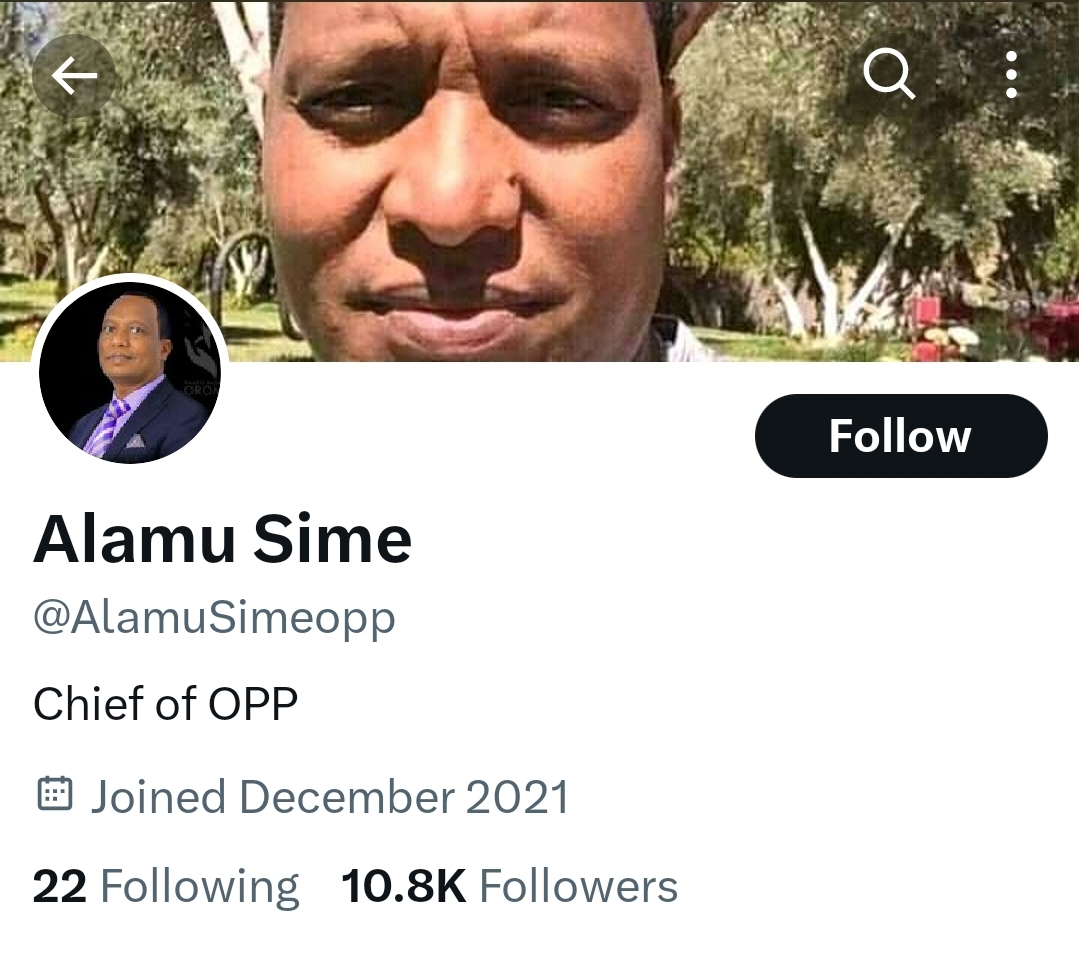
One of the controversies that appeared in the Ethiopian social media landscape last week was a Twitter account in the name of Alamu Sime, Ethiopian Minister of Transport and Logistics.
The Twitter account which has more than 10 thousand followers makes many controversial comments and posts. But one particular post triggered controversy on social media.
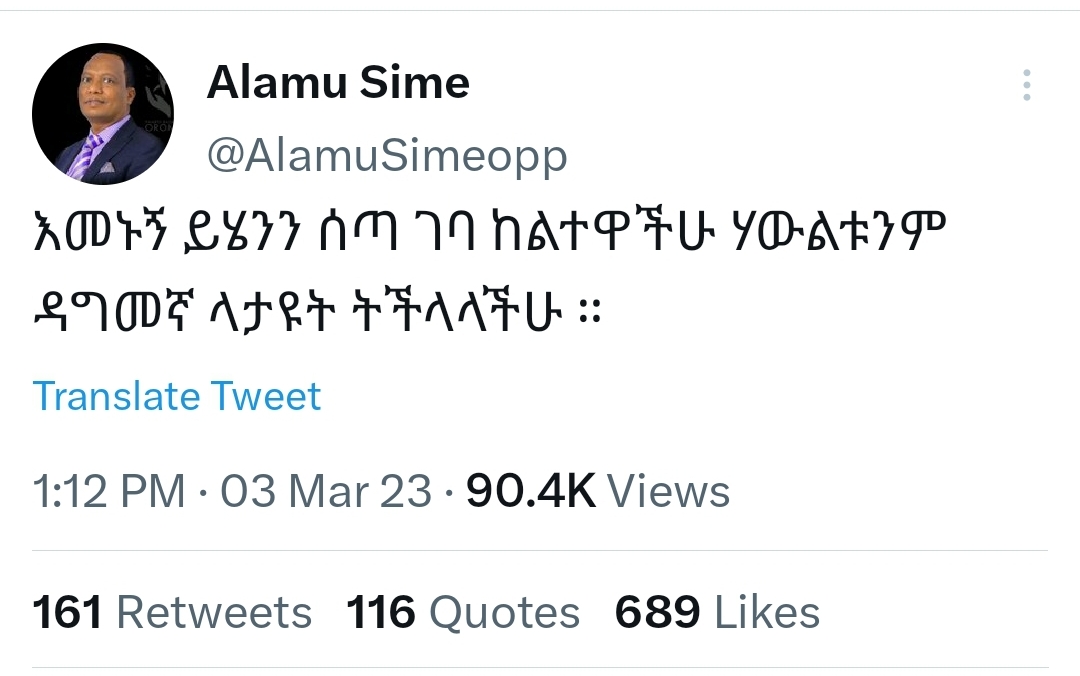
On Mar 3, 2023, the Twitter account wrote, “If you don’t stop the protestation [against the government], you may never see the statue [Menelik II Statue] again.”
The controversial post emerged after a dispute between law enforcement officers and the Adwa Victory Day celebrators broke out on Mar 2, 2023, in Menelik Square.
Nearly 100 thousand users saw the Twitter post and it was shared over two hundred times on the platform.
Later on, it was reported that the Twitter account doesn’t belong to the Minister of Transport and Logistics, Alemu Sime.
Recommendations
HaqCheck recommends social media users be skeptical of unverified social media accounts and the information and post that came out of these accounts.
The impersonated accounts disseminate potentially false and fraudulent information. Social media users should look for additional information and should avoid hasty reactions.
We urge government offices and other institutions to provide the public with timely updates and clarifications.
Social media content creators should also be responsible and refrain from disseminating false disinformation.
The trend of disinformation across the Ethiopian media landscape
Incidents prompt disinformation
Controversial and false information circulation across the Ethiopian social media landscape follows the events that occurred in the country. Events prompt and provoke false information dissemination.
Most of the false claims that appeared and were debunked by HaqCheck were related to events.
The trend of disinformation across the Ethiopian social and mainstream media landscape increases when incidents related to political and socioeconomic issues happen.
Many false claims, videos, images, and controversies pop up the social media landscapes as soon as incidents are reported. Disinformation dissemination campaigns would be observed.
Below are incidents that occurred and provoked false information circulation during the month of February.
Drought in Oromia and Somali regional states
The Oromia and Somali regional states were hit by a severe drought that had been consecutively happening throughout the last five years.
Particularly the Borana Zone of Oromia was highly affected by drought. The drought exposed eight hundred thousand of residents in the zone to immediate food assistance.
The issue was a major issue of reporting and online discussion. Many social media posts and claims appeared sharing images, videos, and news reports.
The controversy within the Ethiopian Orthodox Tewahedo Church
The controversy and schism within the Ethiopian Orthodox Tewahedo Church arose after Abune Sawiros, Archbishop of South West Shoa, along with two archbishops ordained and appointed 26 bishops on Jan 22, 2023, without the recognition of the Holy Synod of the Ethiopian Orthodox Tewahedo Church.
Furthermore, the splinter bishops, citing discriminations within the Ethiopian Orthodox Tewahedo Church against the Oromos and Afaan Oromo ad other languages, announced the establishment of ‘The Synod of Oromia and Ethiopian Nations and Nationalities’.
The Church condemned and excommunicated the bishops.
Consequently, conflict and violence emerged shortly afterward. People were killed and injured due to the conflict.
Later on, the breakaway bishops and the Church signed an agreement on Feb 15, 2023, to settle the problem.
Summary of the debunked claims during the month
Below are the false claims that appeared and were debunked in the month of February.
Eritrean troops were still in Tigray
A Facebook post emerged on Feb 3, 2023, sharing an image with a claim that Eritrean soldiers had not fully withdrawn and were still in northeastern parts of Tigray.
The post used an old image previously published in 2021.
Celebration over the appointment of new bishops in Oromia
A Facebook page shared three images on Jan 27, 2023, claiming that residents of many towns in the Oromia region were celebrating the appointment of new bishops.
The images were taken from a YouTube video published in February 2020.
A church destroyed in Tigray during the war
On Feb 6, 2023, a Facebook post shared an image claiming that the picture shows a church destroyed in Tigray during the war between the Ethiopian government and TPLF forces.
The image really shows a church destroyed in the town of Adi Keyh, Eritrea during the border war between Ethiopia and Eritrea. The picture was taken from a video published by Reuters in April 1999.
Weapons found at an Orthodox church in Shashemene
A claim appeared on Facebook sharing an image that smuggled weapons were found inside the premises of an Orthodox Church in Shashemene.
The same image was previously shared on Facebook on Mar 15, 2021, with a description that the Ethiopian Federal Police seized illicit weapons and ammunition in the Sidama regional state.
Smuggled weapons discovered at Abune Abraham’s house
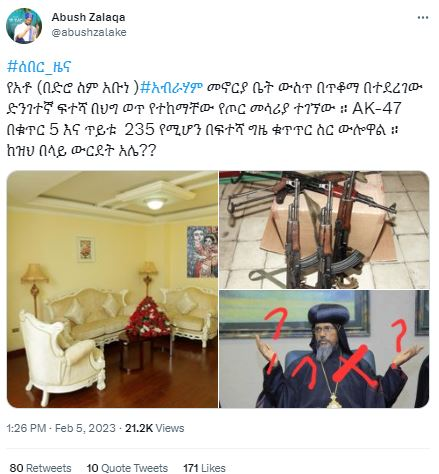
A Twitter post shared three images with a claim that illegal rifles and ammunition were discovered in the house of Abune Abraham, Archbishop of Bahir Dar and head of the Patriarchate Office of the Ethiopian Orthodox Tewahedo Church. The post claimed that police retrieved five Kalashnikov rifles with 235 bullets during a search.
The first image was published on a website that advertises luxury hotels in Addis Ababa. The second picture was published by a news site on September 30, 2020, in a report that India signed a deal with Russia to procure 770,000 Kalashnikov rifles.
Illicit weapons uncovered at the house of an Ethiopian Orthodox Church leader in Jimma
A Facebook page with over 290 thousand followers shared three images claiming that illegal weapons were found at the house of an Ethiopian Orthodox Church leader in Jimma. The first image shows rifles, the second ammunition, and the third is a photo of a person.
However, the images were taken from old publications. The first picture which shows rifles was published on Oct 30, 2019, by the BBC Afaan Oromo along with a news story that the Ethiopian Customs Commision seized illicit weapons.
The second image which shows ammunition was taken from a news article published on Oct 7, 2021, by a local media outlet. The news states that illegal weapons were retrieved in the Addis Ketema district of Addis Ababa.
Recommendations
Haqcheck urges social media users to be skeptical of potentially misleading and fraudulent posts. They should look for additional sources of information before reacting to claims and posts.
We advise public institutions and other concerned entities to give information on a timely basis and clarifications. They should act before damages occur.
Social media content creators are recommended to be responsible and avoid disseminating false and misleading information.
The realization of access to information is the key to combatting disinformation. The lack of information prompts disinformation circulation at a great scale. Government and other organizations work to secure the right of citizens and the media to get access to information.
The controversies HaqCheck observed surfacing the Ethiopian social media landscape were related to the schism within the Ethiopian Orthodox Tewahedo Church.
Controversies arose regarding how the problem was solved and the status of the breakaway synod led by Abune Sawiros. Reports and claims that the breakaway bishops apologized to the Synod of the Ethiopian Orthodox Tewahedo Church while others stated that the bishops had not apologized and the matter was settled through negotiation.
HaqCheck looked into the issue that how was the controversy within the Church settled and what the statements of the deal were signed to solve the schism.
The Background
On Jan 22, 2023, Abune Sawiros, Archbishop of South West Shoa, ordained and appointed 26 bishops without the recognition of the Holy Synod of the Ethiopian Orthodox Tewahido Church.
Seventy bishops nominated by Abune Sawiros have been assigned to dioceses in the Oromia regional state.
The breakaway bishops led by Abune Sawiros announced they established the ‘Synod of Oromia and Ethiopian Nations and Nationalities’.
The breakaway bishops cited discriminations within the Ethiopian Orthodox Tewahedo Church against the Oromos and Afaan Oromo language for the establishment of their synod.
This arose intense controversy and tension within the Ethiopian Orthodox Tewahedo Church.
The Ethiopian Orthodox Church’s Synod immediately convened about the issue and denounced the bishops who participated in the appointment of the breakaway episcopate. The synod excommunicated Abune Sawiros and other bishops for ‘violating the church’s canonical orders’.
A few days later, the breakaway archbishops responded by condemning and excommunicating twelve Ethiopian Orthodox Church archbishops.
On Feb 15, 2023, the breakaway bishops and the Ethiopian Orthodox Tewahedo Church Synod signed an agreement to settle the problem. An agreement was reached with the mediation of the Ethiopian government and the pact was signed in the presence of Prime Minister Abiy Ahmed (Ph.D.).
Terms of the agreement
The bishops agreed to use of Afaan Oromoo language in all churches across Oromia.
They also agreed to allocate a budget for the enhancement of the use of the Afaan Oromo Language and expand the human resources in the Oromia regional state so that clergies who speak the language could be dispatched.
The deal states that the Church agreed to open universities and colleges that teach theology in Afaan Oromo, to appoint bishops who speak the language of Oromia dioceses.
The breakaway bishops held a meeting after the deal was signed and stated that they accept the agreement. They stated that they didn’t violate the canonical law of the Church when they ordain bishops and form a synod a month earlier.
The Church gave a briefing that the breakaway bishops were still violating the laws of the Church even after the deal was signed.
A day later, they both announced that they would comply with the agreement signed on Feb 15, 2023.
Recommendations
We recommend social media users be cautious of potentially misleading and fraudulent posts and look for additional sources of information before reacting.
Public offices are urged to provide sufficient and timely information about current events and issues. The media and the public should enjoy the right to access information.
HaqCheck urges social media content creators to be responsible and refrain from becoming agents of disinformation.
The false claims and controversies during the week were regarding the schism within the Ethiopian Orthodox Tewahedo Church and related conflict.
HaqCheck observed that the trend of disinformation had intensified during the week. Many false images were shared to support claims. Most of the claims accompanied by false images and debunked by HaqCheck were regarding the holding and discovery of smuggled weapons at Church leaders’ houses.
Below are the claims HaqCheck debunked in the second week of February 2023.
A church destroyed in Tigray during the war
On Feb 6, 2023, a Facebook post shared an image claiming that the picture shows a church destroyed in Tigray during the war between the Ethiopian government and TPLF forces. The Facebook claim alleged that the Ethiopian Orthodox Tewahdo Church was a collaborator when churches were destroyed in Tigray during the war.
Days after the war broke out between the TPLF and the Ethiopian government, the Ethiopian Orthodox Tewahido Church expressed its support for the Ethiopian armed forces on Nov 17, 2020.
News reports indicate that churches were damaged in Tigray regional state during the armed conflict.
The Facebook post emerged amid intense tension within the Ethiopian Orthodox Church after Abune Sawiros, Archbishop of South West Shoa, ordained and appointed 26 bishops without the recognition of the Holy Synod of the Ethiopian Orthodox Tewahido Church on Jan 22, 2023.
Yet, HaqCheck confirmed that the image was old and doesn’t support the claim that it shows a church destroyed in Tigray during the recent war.
The image shows a church destroyed in the town of Adi Keyh, Eritrea during the border war between Ethiopia and Eritrea. The picture was taken from a video published by Reuters in April 1999.
Weapons found at an Orthodox church in Shashemene
HaqCheck came across a Facebook post sharing an image with a claim that smuggled weapons were found inside the premises of an Orthodox Church in Shashemene.
However, the picture was old and published two years ago. The image was previously shared on Facebook on Mar 15, 2021. It was shared with a description that the Ethiopian Federal Police seized illicit weapons and ammunition in the Sidama regional state.
Smuggled weapons discovered at Abune Abraham’s house
A viral Twitter post appeared on Feb 5, 2023, sharing three images with a claim that illegal rifles and ammunition were discovered in the house of Abune Abraham, Archbishop of Bahir Dar and head of the Patriarchate Office of the Ethiopian Orthodox Tewahedo Church. The post claimed that police retrieved five Kalashnikov rifles with 235 bullets during a search.
However, the pictures were old and don’t support the claim. The first image was published on a website that advertises luxury hotels in Addis Ababa. The website claims that the image is of a hotel in Bole named Sheger Royal.
The second picture was published by a news site on September 30, 2020, in a report that India signed a deal with Russia to procure 770,000 Kalashnikov rifles. The third image shows Abune Abraham.
Illicit weapons uncovered at the house of an Ethiopian Orthodox Church leader in Jimma
A Facebook page with over 290 thousand followers shared three images on Feb 7, 2023, claiming that illegal weapons were found at the house of an Ethiopian Orthodox Church leader in Jimma. The first image shows rifles, the second ammunition, and the third is a photo of a person.
The post claimed that the person in the photograph is the deputy chairman of the parish council of a local church in Jimma and head of the Jimma branch of Mahbere Kidusan, a religious association within the Ethiopian Orthodox Tewahido Church.
However, the images were taken from old publications. The first picture which shows rifles was published on Oct 30, 2019, by the BBC Afaan Oromo along with a news story that the Ethiopian Customs Commision seized illicit weapons.
The second image which shows ammunition was taken from a news article published on Oct 7, 2021, by a local media outlet. The news states that illegal weapons were retrieved in the Addis Ketema district of Addis Ababa.
Recommendations
HaqCheck advises social media users to be cautious incase they encounter potentially misleading posts. They should quest sufficient and accurate information before reacting to claims and posts.
Public offices and other institutions are urged to provide the media and the general public with sufficient and timely updates regarding ongoing public matters.
The government and other relevant organizations should work towards the realization of the right of citizens and the media to access information.
Social media content creators should be responsible and refrain from making and disseminating false and misleading information.
The peace agreement between the Ethiopian government and the TPLF in November 2022 concluded the war that broke out exactly two years ago.
The Eritrea Defence Forces, Amhara regional militia, and other armed forces had been involved in the war alongside the federal government of Ethiopia against TPLF forces.
The peace agreement signed in Pretoria, South Africa asserts that TPLF forces shall surrender their weapons and foreign and non-ENDF armed forces to leave the regional state of Tigray.
The Ethiopian government and the TPLF agreed that the disarmament of heavy weapons of the TPLF should be done concurrently with the withdrawal of Eritrean and non-ENDF forces from the Tigray.
Recent news reports indicate that Eritrean soldiers started withdrawing from Tigray last month. They left the towns of Aksum, Adwa, and Shire. Additionally, Amhara regional armed forces also reportedly left Shire town.
Yet, it is still unknown whether the non-ENDF and Eritrean troops have fully withdrawn from the Tigray regional state.
Against this backdrop, a Facebook post emerged on Feb 3, 2023, sharing an image with a claim that Eritrean soldiers had not fully withdrawn and were still in northeastern parts of Tigray.
Yet, the image was old and taken from a publication made in May 2021. The picture was first published along with a news story by CNN.
Therefore, HaqCheck rendered the post False.
Celebration over the appointment of new bishops in Oromia
On Jan 22, 2023, Abune Sawiros, Archbishop of South West Shoa, along with two archbishops appointed 26 bishops without the recognition of the Holy Synod of the Ethiopian Orthodox Tewahido Church. Seventy of the bishops appointed by Abune Sawiros were announced to be dispatched to churches in the Oromia regional state.
Following this appointment, the Ethiopian Orthodox Tewahido Church denounced the act. The Church also excommunicated Abune Sawiros and other bishops who co-organized the appointment.
A few days later, the breakaway archbishops announced that nominee bishops would soon be dispatched to various parishes in Oromia.
Social media reports indicate that the newly appointed bishops were sent to their respective domains and were warmly received by residents.
In this context, the Facebook page followed by over two million accounts shared three images on Jan 27, 2023, claiming that residents of many towns in the Oromia region were celebrating the appointment of new bishops.
The images, however, do not support the claim. The first two images in the post were taken from a YouTube video published in February 2020.
The third picture depicts Abune Sawiros who appointed the new bishops. The image was recently posted on Facebook.
Recommendations
Social media users are recommended to be skeptical of potentially misleading and fraudulent posts. They should look for additional information before reacting.
HaqCheck urges public offices and other institutions to offer sufficient and timely updates regarding ongoing issues that are of public interest.
The government should secure the right of citizens and the media to access information.
We recommend social media content creators be responsible and avoid circulating false and misleading information.
Almost all the social media false claims debunked by HaqCheck last week were related to an ongoing conflict in the Oromo Special and North Shewa zones of the Amhara regional state.
The Ethiopian social media landscape is always dominated by posts related to ongoing incidents. Media reports indicate that there was an ongoing conflict in the North Shewa and the Oromo Special zones of the Amhara regional state.
Thus, the claims and controversies during the week were mostly related to the looming conflict in the areas of the two zones which are characterized by ethnic and religious diversity.
HaqCheck did three fact-checking articles last week. A summary of the issues is presented below.
A video of torched Oromo houses
On Jan 23, 2023, a video was shared by a Facebook page with more than six thousand followers claiming that houses belonging to ethnic Oromos were torched in an ongoing conflict in the Oromo Special Zone of the Amhara region.
The claim emerged amid surfacing social media reports that there was an ongoing conflict in areas of the two volatile zones. The post claimed that the video shows Oromo houses being burnt in an ongoing conflict in the Amhara region.
The video, however, does not support the claim. The video was made up of images by converting a picture into a moving image or video.
The original image was taken from an old publication made on Dec 23, 2020. The original image was published along with a report that many civilians were massacred in the Metekel zone of Benishangul Gumuz.
Therefore, the post was rated False.
A false image of a recent conflict in Ataye town, Amhara region
An image was shared on Facebook with a claim that the picture shows an ongoing violent conflict in the town of Ataye, Amhara regional state. The image was posted along with two others on Facebook on Jan 24, 2023, by a page that has over five thousand followers.
The same image was also shared in another Facebook post with the same claim that it shows an ongoing conflict in Ataye.
The posts by the Facebook pages with over five thousand followers each are expected to reach many audiences.
Yet, HaqCheck confirmed that the image was old and doesn’t show an ongoing conflict in the area. However, HaqCheck investigated the claim and confirmed that the image was old.
The original picture was first published on Facebook in April 2019 with a caption that the image shows a church destroyed by fire in the town of Ataye at that time.
Therefore, the claim was rated False.
OLA militants attacked police officers in Jewha, Amhara regional state
Oromo Liberation Army militants opened a sudden attack on a camp and killed more than 20 police officers during an ongoing conflict in Jewha town, Amhara regional state, claimed a Facebook post made on Jan 22, 2023. The claim was backed with an image.
The claim was made in the context of the ongoing conflict in the area. However, HaqCheck investigated the image and confirmed that the image used to support the claim was old.
The image was originally published on a website on March 20, 2021, along with a short news story.
Thus, HaqCheck rated the post as False.
Recommendations
HaqCheck urges social media content creators and influencers to be responsible and avoid disseminating false information.
We recommend social media users be cautious and look for additional sources for misleading and controversial claims.
The government and public offices are recommended to provide updates and sufficient information about ongoing public matters.