July: Disinformation Trend In Ethiopia

Background

There has been an ongoing war in the northern part of Ethiopia since November 2020. The conflict started after Prime Minister Abiy Ahmed ordered a military offensive against regional forces in Tigray accusing them for attacking the northern command and taking away the artillery. And the fighting has been active for the past nine months. 

The Tigray People’s Liberation Front (TPLF)  denies starting the conflict saying it had struck preemptively because federal forces were preparing to assault Tigray, and the government wants to dominate their ethnic group for centralized power. 

The nine months-long ongoing war has contained several issues. The Situation has been changing quickly  and it was full of action. The regional capital Mekele was captured by the government forces after three weeks of the beginning of the war. After eight months of conflict the government declared a unilateral ceasefire and withdrew its defense forces. TPLF then  captured the regional capital . The parliament also labeled the party as a terrorist. 

During the course of the war, unconfirmed issues, rumors, conspiracies, and controversies filled the information sphere, especially social media, regarding the conflict in the north. Different ways were used to disseminate disinformation and to create controversy in the past month. 

Usage of Images

The article “How Local Guerrilla Fighters Routed Ethiopia’s Powerful Army”, by The New York Times, with images of armed children, garnered attention. The article refers to the children as “…highly motivated young recruits…” which raised a question of war crimes, and the promotion of recruiting child soldiers.

The image used by The New York Times, that was changed later

Even though TPLF didn’t comment on the issue, the images were later changed with other photos.

Another article by Amnesty International calling “End the arbitrary arrests of Tigrayans” was criticized for using an unrelated image. Even though the article confirmed  the reports that claim Tigrayans are being detained in Addis Ababa, the picture used by Amnesty shows a policeman searching people, who were on a queue  during the June’s election. The picture was first used by  AFP. The photographer was mentioned in the article, but Amnesty didn’t clarify that the image was taken on election day. The image was later changed. 

Screenshot of the statement by Amnesty international before it was edited
Screenshot of the article by AFP

One of the other controversies was related to the recapturing of Alamata, by TPLF forces. An image with the claim that the rebel army had seized a pickup truck of Amhara police forces went  viral. The people in the image were holding and showing the license plate of the vehicle. However, some people argued that both the car and the plate were photoshopped and did not prove the vehicle had been captured. Some edited versions of the original image were also shared to disprove it.

Content that was released with images of children alleging that the TPLF, which was designated by the House of Peoples’ Representatives as a terrorist organization, is conscripting child soldiers into fresh battles also raised an argument.

One side claimed that the children and adults in the images were captured in neighboring Afar and Amhara regions during fresh battles. Different media outlets released video clips of interviews showing the supposed child soldiers. 

As a counterclaim, others argued that the women and children in the images and video clips aren’t child soldiers conscripted by TPLF. They instead asserted that they are returnees from Saudi Arabia and have been forced by the government to be interviewed and give scripted interviews. For instance, a Facebook page with 20,433 followers claimed that one of the interviewees is a Saudi returnee and was forced to give the interview falsely and appealed to users to share the post. The post was shared more than 1,500 times across the platform. This shows how claims can circulate on social media widely.

The blockage of both road and railway between Djibouti and Addis Ababa was another controversial issue during the week. 

Reports stated that the road and the railway, which is a corridor for 95% of imports to the Ethiopian capital from its eastern neighbor, were blocked by  young protesters. The cause of the protest is said to be down to an attack on Gedamaytu town, in the Somali region, by special forces and militia from the neighboring region of Afar. Even though Somali region officials and residents alleged hundreds of people had been killed in the attack, no statement was given from the Afar region or the federal government. The information gap made it easier to share it in a lot of different contexts that misled the public.

Besides the image-based controversies, there were also different claims here and there, seen using inaccurate images. Some of them were debunked by HaqCheck. 

A false image, posted on Facebook, claimed that the dead bodies of Amhara special forces had been taken to Gondar by Sino trucks. However, HaqCheck debunked the false image and information and confirmed that the image was taken from an advertisement. HaqCheck proved the picture of the truck was posted on 23 Dec 2019, on an online trading platform.

The other claim was information that stated firearms, ammunition, and military clothes had been captured from the TPLF Forces by the Afar Regional forces. HaqCheck found out the Facebook post used an old picture and other unconfirmed images. Similarly, another image was posted claiming to show captured TPLF forces by the Afar special forces. It used a picture that was actually posted on November 7, to support its claim.

Another Facebook post claiming a trusted military source confirmed a warehouse with a large stockpile of weapons set up [by TPLF] to control Afar and Amhara regions burned down to ashes by FDRE Air Force. The Facebook story also claimed that the incident happened at a place around Kaluwa, the border of Afar and Amhara regions. The images used in the post were taken at different times with different photographers and incidents.

A Facebook post claiming mothers in Mekelle, capital of the Tigray Region, were going out onto the streets to condemn the acts of the Tigray People Liberation Front (TPLF) was also looked into by HaqCheck. However, the image that was posted with the claim was an old picture that first appeared on social media on 21 October 2018. 

Unconfirmed controversial issues

Even though the federal government did not give an official comment, the Amhara regional state government announced that it had shifted from “defense to offense in the re-invasion of various parts of the state.” Following the announcement by the Amhara regional state, other regional state special forces also started to deploy their special forces to Tigray. 

Following that social media posts that said “the Sidama special forces had refused to be deployed to Tigray” went viral. However, it was reported later, that the special force was “moving to stand with the national defense force, accepting a national call”.

Recent claims about Woldia town, located in the North Wollo zone of the Amhara region, filled the social media sphere from different sides. One side claimed that Woldia city is in the control of TPLF and the federal defense force was in retreat leaving its heavy weapons and vehicles. 

On the other side, there was a statement on the official Facebook page of Amhara region communication saying “Woldia city and the surrounding areas are peaceful”

Controversial issues based on interviews

An article entitled “From Nobel Hero to Driver of War, Ethiopia’s Leader Faces Voters”, published on June 21, by The New York Times, also created controversy in the past month. The article narrates a conversation between Senator Chris Coons and Prime Minister Abiy Ahmed about the war in Tigray. 

Screenshot of the article before it was edited

As mentioned in the article, the conversation was made on Nov 3, which was before the conflict broke out. But their phone conversation was actually on Nov 23, which the article was later edited to reflect. The writer, Declan Walsh, also announced that the article had been corrected, saying: “After publication Senator Coons said he misremembered the date and the story has been corrected and appended.”

Another issue was raised based on rumors and unconfirmed claims on social media, that former politicians and statesmen including Lemma Megersa, Siye Abraha, Tamrat Layne, Yared Tibebu, Dawit Weldegiorgis, Birhane Gebrekirstos, and others – are saying they are going to reconcile the federal government and TPLF in addition to conspiring against the government at the same time.

Following that other claims arose saying that the former Oromia regional President, Lemma Megersa, had rejected the allegation. He was said to have called for an end to trading on his name, in an apparent interview with VOA Afaan Oromoo.

However, VOA Amharic announced that there was no recent interview with Lemma Megersa. In the statement on July 28, VOA’s Afaan Oromo Editor-in-Chief, Nemo Dandi said “there was no attempt to contact Lemma for an interview, the idea was not even raised.” 

The issue about Addis Ababa, Bole International Airport

Early in the week, a number of posts on Facebook and Twitter went viral, claiming that Addis Ababa, Bole International Airport had halted operations and was closed.

But the airport had only stopped operations due to adverse weather conditions. Flights heading to Addis Ababa were diverted to nearby airports due to fog and heavy rain. Two Ethiopian Airlines and one Turkish Airlines flight were impacted. 

Later on, Monday flights resumed from and to Bole International Airport. Ethiopian Airlines announced that it was able to reroute the flights that had been diverted after weather conditions improved. 

“The weather conditions are still unreliable which can change at any time and we’ll continue to update you on the progress,”  a statement from the airlines said at the time. 

Recommendation

Based on the trends observed in the past month, information disorder aggravates situations during political instability. This worsens when the availability of information to the public is limited. In this case, HaqCheck believes that the information gap accelerates the spread of disinformation. To minimize its damage, the government, public figures, and other concerned bodies should provide updates and allow access to information to the media and the general public since making the right information available in a timely fashion is vital for combating disinformation. 

Some international media and organizations were also part of the misinformation spread the past month. They should be responsible for their reporting. They should care for humanitarian affairs as inaccurate information inflicts long-term damage on societies especially on those with less [media] literacy.

Social media activists and public figures should also refrain from spreading unconfirmed information and disinformation.

Media outlets should focus on providing the public with timely, accurate, and reliable information regarding ongoing situations. The journalists should stick to basic journalism principles and report accurate information without any bias, mainly about sensitive issues. They should also work hand in hand, with the concerning bodies, to enhance the media literacy of the public.

The public should be aware of such information disorders and protect themselves from not sharing unconfirmed information. Not all information coming from social media and not all images are true, so they should rely on information from credible sources. 

—————————————————————————————————————————————————

HaqCheck is a local multilingual fact-checking project based in Ethiopia, formed inside Addis Zeybe’s newsroom, now Inform Africa’s Counter Disinformation Project – a board-led Civil Society Organization (CSO) – dedicated to verifying media contents from social to the mainstream. HaqCheck works in collaboration with media outlets to monitor media contents in English and four local languages (Amharic, Afaan Oromo, Tigrigna, and Somali).

This report is produced with the support of UNESCO under the #CoronavirusFacts: Addressing the ‘Disinfodemic’ on COVID-19 in conflict-prone Environments that the UNESCO Addis Ababa Office is implementing in Ethiopia with financial support from the European Union (EU). The designations employed and the presentation of material throughout this publication do not imply the expression of any opinion whatsoever on the part of UNESCO or the EU concerning the legal status of any country, territory, city, or area or of its authorities, or concerning the delimitation of its frontiers or boundaries. The ideas and opinions expressed in this publication are those of the authors and do not necessarily reflect the views of UNESCO or The European Union and do not commit these organizations in any way.

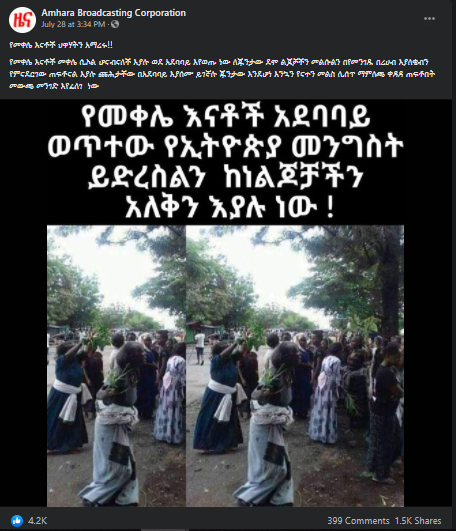
Does the image show mothers in Mekelle condemning the TPLF?

A Facebook page with over 212,7570 followers posted a photo with text that says mothers in Mekelle, capital of Tigray Region, are going out to the streets to complain over the acts of the Tigray People Liberation Front (TPLF).  

Posted on July 28, the Amharic written text reads: “Mothers in Mekelle complained over TPLF! The mothers of Mekelle are going out to the streets saying that “Mekelle has turned to hell, asking the “Juntas” sorrowfully to bring back their children from the war zone saying the kids are dying in hunger…“. 

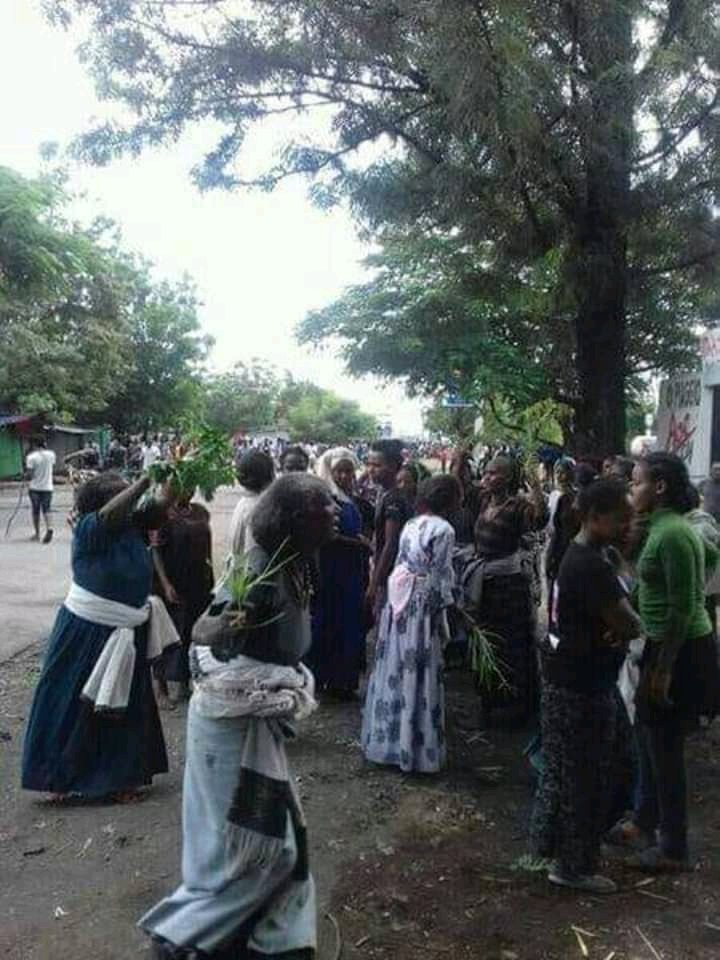
The claim is supported by an image, which shows elderly women mourning on the street. The post has been shared more than 1,500 times up until this article was published. HaqCheck looked into the post and has rated it as FALSE.

The Ethiopian federal government has been battling the Tigray People’s Liberation Front (TPLF) since November 2020 after accusing it of attacking military bases in the restive region. Following three weeks of armed conflict, the federal government occupied the regional capital city, Mekelle, and most parts of the regional state.

During the armed conflict, it was reported that TPLF officials had been captured and killed by the Ethiopian National Defense Force (ENDF). However, the international community also accused the Federal government, ENDF, Amhara special forces and militia, and Eritrean troops of crimes against humanity including massacres and rapes.

After eight months of the war, the Ethiopian government announced that it had decided to withdraw troops from the region and declare a humanitarian ceasefire. After being dislodged by Ethiopia’s military, the former leaders of the region claimed to have regained control on 28 June 2021 over the regional capital.

Based on the story that was published on Financial Times’s front page and other allegations, it was reported that TPLF is conscripting child soldiers into fresh battles. Interviews of the mentioned captured child soldiers were also released. Over the past weeks after the TPLF forces retook the regional state, different information is coming out on social media, including the one posted by the page.

HaqCheck looked into the image posted by the page. A reverse image search of the image shows that the image was first posted on 21 October, 2018Twitter. The tweet was shared in the context that there were protests around Raya Alamata about Raya people in the Tigray region raising identity questions during that time.

Original Image 

Despite reports that TPLF is conscripting child soldiers, HaqCheck has confirmed that the image does not show crying mothers in Mekelle, rendering the post False due to the inaccuracy of the image. Additionally, HaqCheck observed that up until the time this article was published there had been no official report of related incidents from any side.

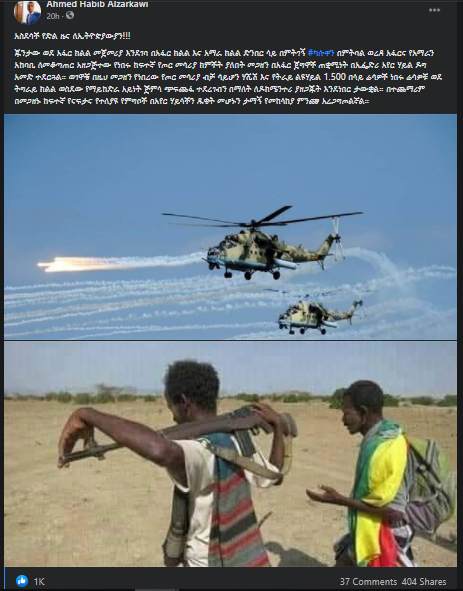
Do the images show the Ethiopian Air Force burning down a warehouse of weapons in Afar?

A Facebook page with more than 42,000 followers posted two images with Amharic captions that read “Good Victory News for Ethiopians”. Posted on July 22, the story claimed that a trusted military source confirmed a warehouse with a large stockpile of weapons set up [by TPLF] to control Afar and Amhara regions burned down to ashes by FDRE Air Force. The Facebook story also claimed that the incident happened at a place around Kaluwa, the border of Afar and Amhara regions. The post has been shared more than 400 times in less than 24 hours.

HaqCheck looked into the post and rated it as False due to the usage of inaccurate images to support the claim.

On November 4, 2020, armed fighting started between TPLF-led regional and federal government-led forces in Tigray. In the ensuing conflict, the federal army has controlled major areas in Tigray, but there have been reports of active war and guerilla fighting across the region. The Federal government also announced it had captured and killed TPLF senior military and civil officials.

Late last month the Ethiopian government declared a sudden unilateral ceasefire for “humanitarian purposes” and immediately withdrew its forces from the mainlands of the regional state. As a reason for the withdrawal, the federal government mentioned a request from the Tigray Interim Administration. 

The TPLF-forces have been advancing southwards and southeast, moving out of the heartlands of Tigray. Recently armed clashes have been reported in border areas adjacent to Tigray, Amhara, and Afar regional states.

The Facebook post was circulating amid this situation.

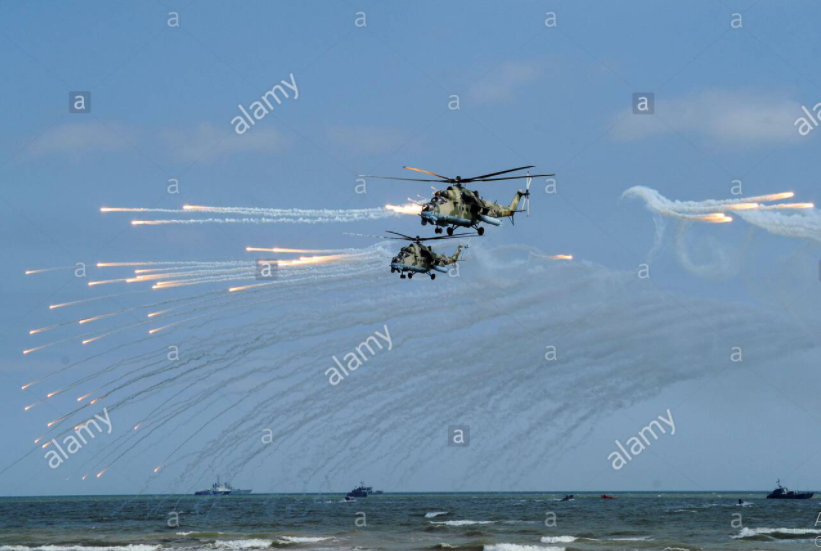
However, a reverse image search of both the pictures shows that the images were taken at different times and are not actually related to the current situation around the regions. The first image that shows two helicopters firing was taken by Sergey Pivovarov, on September 20, 2019, while Russian mi-35 attack helicopters fire during military exercises. The original image is available on c Alamy, an online image stock. 

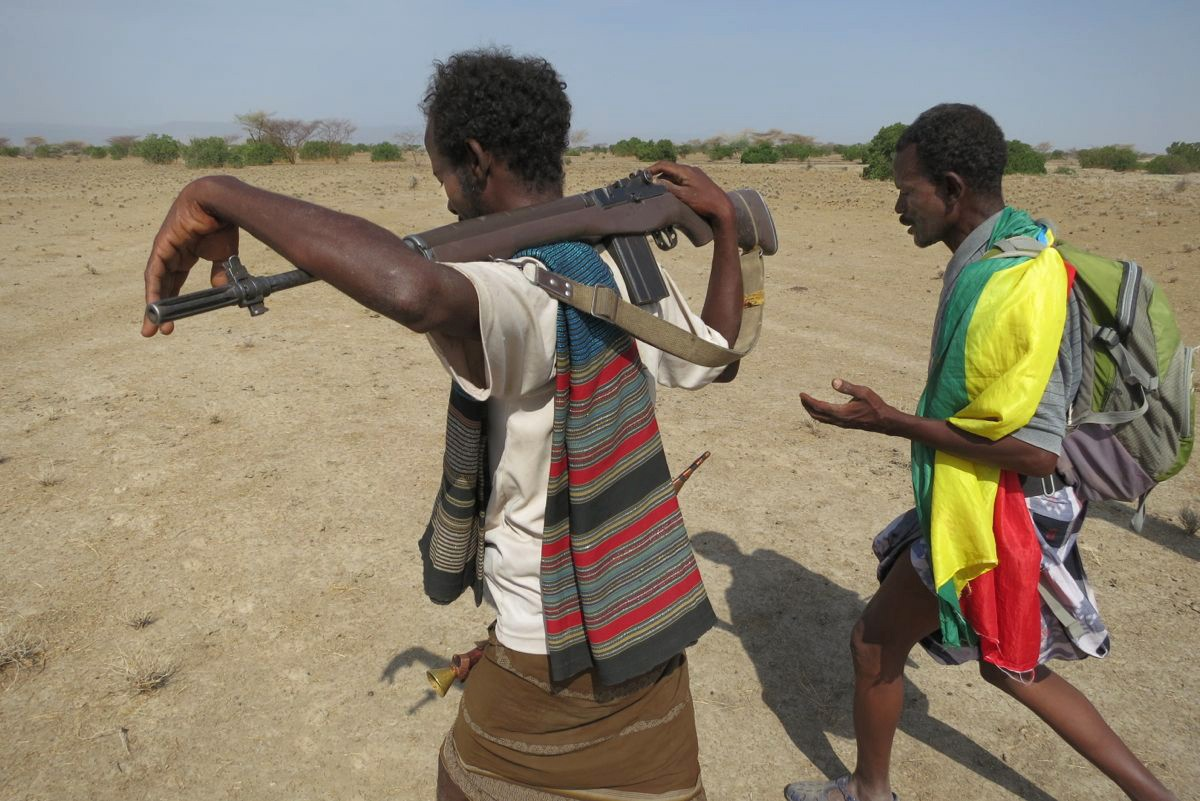
The second image showing an armed man and another man wearing what seems like an Ethiopian flag was actually taken by Paul Salopek. It is part of journalist Paul Salopek’s multiyear, “21,000-mile walk across the world in the footsteps of our forebears”, which was published on February 04, 2013. The image can be found on the National Geographic website.

First image

Second image

HaqCheck also could not find any official report from the Air force or other media outlets regarding the situation.

Even though there have been reports of fresh armed conflicts in the areas that border the Tigray, Amhara, and Afar regions, HaqCheck confirmed that the images do not show an incident where the Ethiopian Air Force is destroying a warehouse of weapons in Afar. Therefore we rated the post as FALSE due to the usage of inaccurate images to support the claim.

.

Does the image show TPLF soldiers that were captured by the Afar special forces?

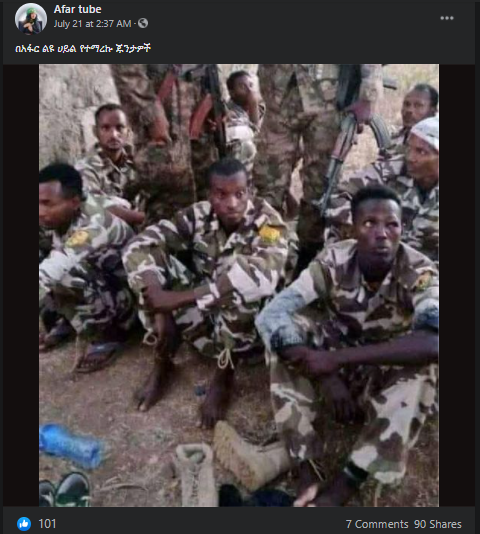
A Facebook page with more than 6,000 followers posted an image on July 21 showing a group of people wearing a military uniform. The Amharic caption reads “Juntas” captured by Afar Special Forces. The post had been shared more than 90 times by the time this article was published.

HaqCheck looked into the post and declared the post False due to the usage of inaccurate images to support the claim.

On November 4, 2020, armed fighting started between TPLF-led regional and Federal government-led forces in Tigray. In the ensuing conflict, the federal army has controlled major areas in Tigray, but there have been reports of armed battles and guerilla attacks in the region. The Federal government captured and killed TPLF senior military and civil officials.

Late last month the Ethiopian government, following a request from the Tigray Interim Administration, declared a sudden unilateral ceasefire for “humanitarian purposes” and immediately withdrew its forces from the mainlands of the regional state.

After federal forces left the region, the TPLF-forces rebranded themselves as Tigray Defense Forces (TDF), taking control of urban centers of the regional state.

The TPLF-forces have been advancing southwards and southeast, moving out of the heartlands of Tigray. Recently armed clashes have been reported in border areas adjacent to Tigray, such as Amhara and Afar regional states.

The Facebook post was circulating amid this situation.

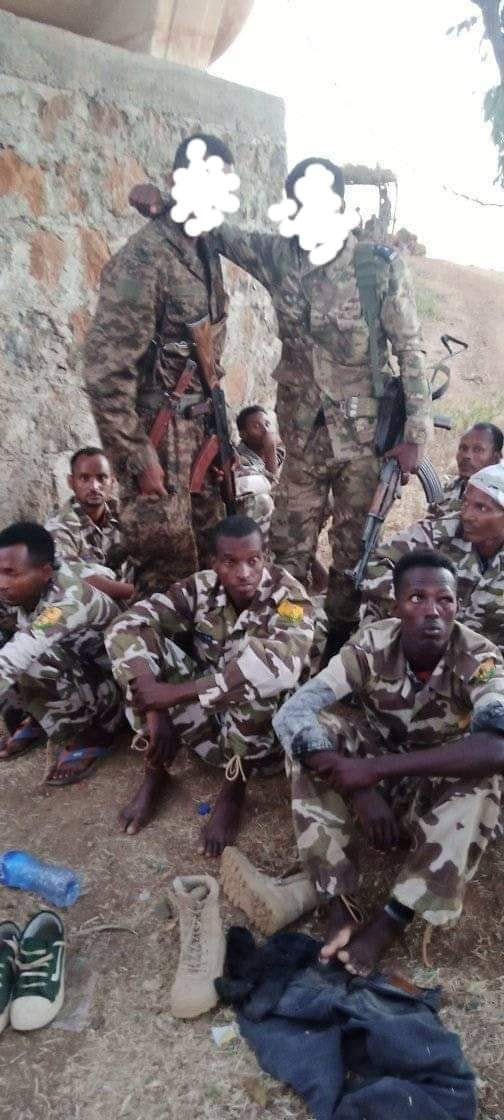
However, a reverse image search of the picture shows that the image was taken at a different time and is not actually related to the current situation around the Afar region. HaqCheck found out the image is cropped and the former image can be found in another Facebook post from November 07, 2020. As well as the people in military uniforms on the ground, the full image HaqCheck sourced shows two men wearing the ENDF uniform standing in the middle.

Formerly used image

Despite the reports of fresh armed conflict in the areas that border the Tigray, Amhara, and Afar regions, HaqCheck confirmed that the images do not show TPLF soldiers captured by the Afar special forces. Therefore we have labeled the post-FALSE due to the usage of inaccurate images to support the claim.

.

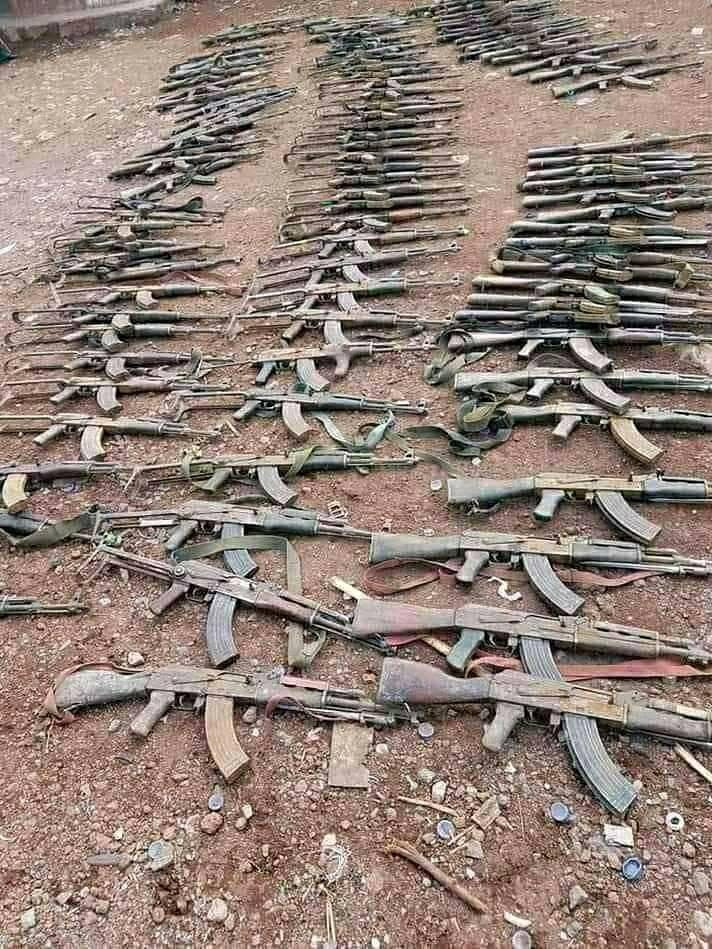
Do these images show firearms seized from TPLF-forces by Afar Regional Forces?

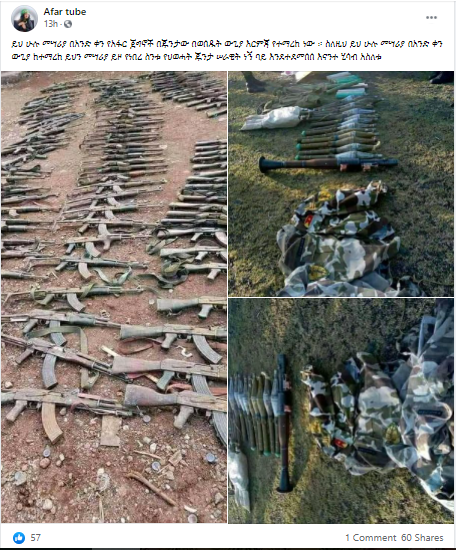
Three images showing firearms and military clothes started circulating on a Facebook page on July 22, 2021. The post, published on a ‘personal blog’ page with 4,172 followers, claimed that firearms, ammunition, and military clothes had been recently captured from the Tigray People’s Liberation Front (TPLF) Forces by the Afar Regional Forces. The post, which said it happened during an offensive against the TPLF, has gone viral, and more than 60 Facebook users have shared it.

HaqCheck has investigated the images and the post, confirming that one of the pictures does not show munitions seized by Afar regional forces from TPLF forces during a military operation recently conducted. While we have been unable to determine the veracity of the other two images, HaqCheck has rated the post as FALSE due to the usage of an inaccurate picture out of the three images.

On November 4, 2020, armed fighting started between TPLF-led regional and Federal government-led forces in Tigray. In the ensuing conflict, the federal army has controlled major areas in Tigray, but there have been reports of armed battles and guerilla attacks in the region. The Federal government captured and killed TPLF senior military and civil officials.

Late last month the Ethiopian government, following a request from the Tigray Interim Administration, declared a sudden unilateral ceasefire for “humanitarian purposes” and immediately withdrew its forces from the mainlands of the regional state.

After federal forces left the region, the TPLF-forces, rebranded themselves as Tigray Defense Forces (TDF), took control of urban centers of the regional state.

The TPLF-forces have been advancing southwards and southeast moving out of the heartlands of Tigray. Recently armed clashes have been reported in border areas adjacent to Tigray, Amhara, and Afar regional states.

Amid the situation, the Facebook post claimed that the munitions in the images were captured by Afar regional forces from TPLF-armed groups.

However, a Google reverse image search shows that the first picture of the three images doesn’t back the claim. 

The first image shows 105 illegal light weapons which were seized on March 7, 2019, in Burayu, Oromia, on the way from Gambella to Amhara regional state via Addis Ababa. The image was posted by OBN Afaan Oromoo on the same day. Here is the link to the original image. HaqCheck couldn’t determine the accuracy of the second and the third images, which are the same image taken but rotated and altered into different dimensions (rotated image).

There have been reports of fresh armed conflicts in the areas that border the Tigray, Amhara, and Afar regions. However, HaqCheck has interrogated the post and the images and confirmed that the first image of the three pictures was taken from another post three years ago which undermines the claim. HaqCheck has therefore rated the post as FALSE due to the usage of an inaccurate picture out of the three.

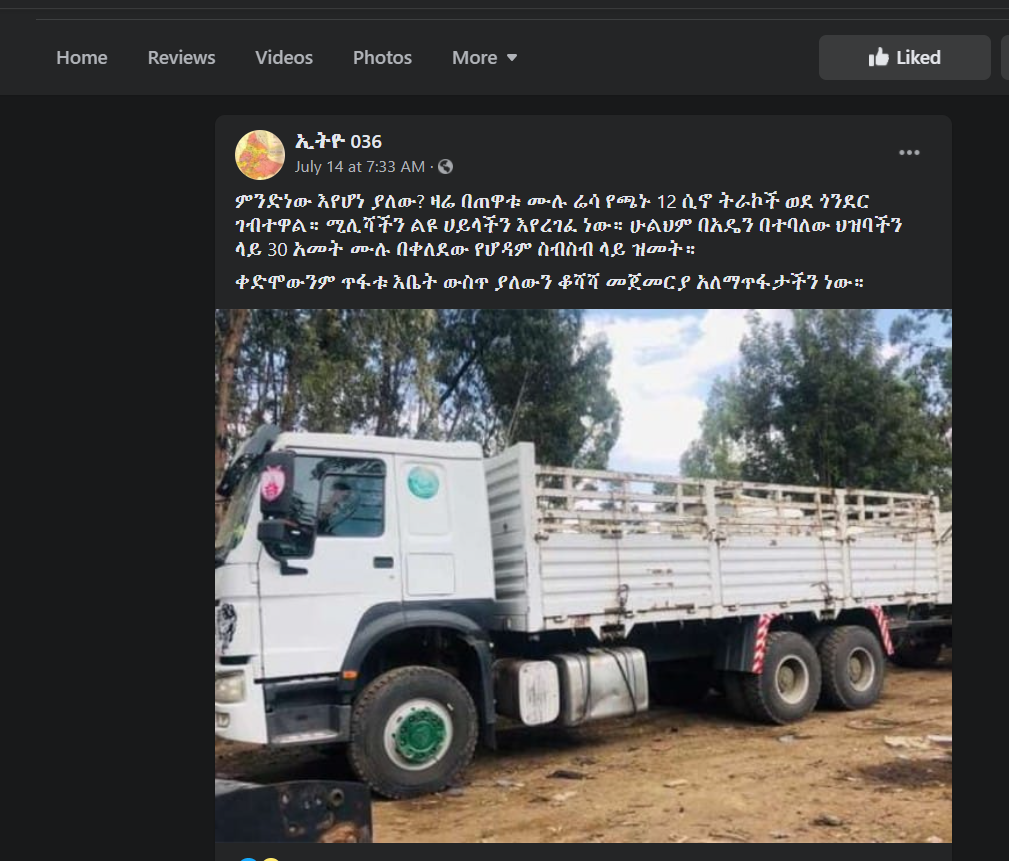
Does the image show dead bodies loaded in trucks arriving in Gondar?

A Facebook page with over 11,450 followers posted claims on July 14 2021 that dead bodies of Amhara special forces had been taken to Gondar by Sino trucks, a type of vehicle widely used for construction purposes in Ethiopia. 

The text written in Amharic reads: “What’s going on? 12 Sino Trucks loaded with dead bodies arrived in Gondar, earlier this morning. Our Militia, our special forces are dying…“.

HaqCheck looked into the post and has rated it as False.

The federal government has been battling the Tigray People’s Liberation Front (TPLF) since November 2020 after accusing it of attacking military bases in the restive region. Following three weeks of armed conflict, the federal government occupied the regional capital city, Mekelle. 

During the battle, it was reported that TPLF officials had been captured and killed by the Ethiopian National Defense Force (ENDF). However, the international community also accused the Federal government, ENDF, Amhara militia, and Eritrean troops of crimes against humanity including massacres and rapes. 

After eight months of the war, it was reported that the Ethiopian government had made the decision to withdraw and declare a ceasefire in Tigray. After being dislodged by Ethiopia’s military, the former leaders of the region claimed to have regained control on 28 June 2021 over the regional capital.

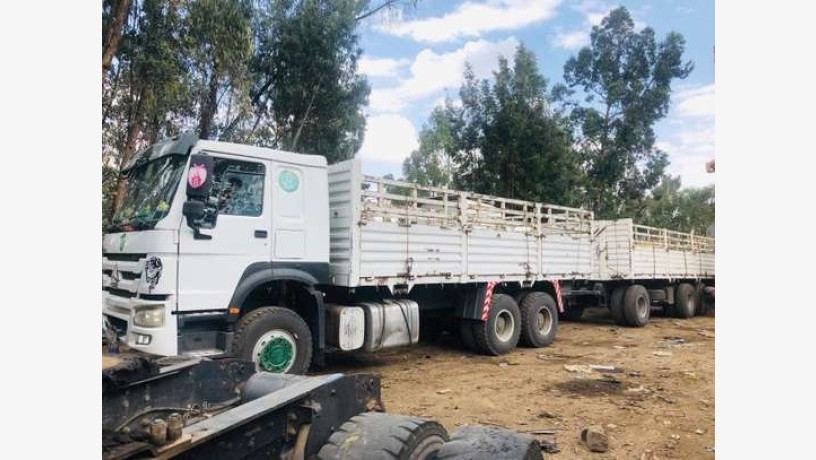
HaqCheck looked into the image posted by the page. A reverse image search of the image shows that the image was first posted on 23 Dec 2019, by Loozap Ethiopia, an online platform for selling and buying products. The image was shared to advertise the sale of a two million Birr Sino truck. Also, the image used by the page is manipulated and cropped from the original one.

Original Image 

Additionally, HaqCheck observed that up until the time this article was published there had been no official report of related incidents from neither the Amhara national regional government nor the TPLF. 

Despite the ongoing conflict in the areas bordering the Amhara and Tigray region, HaqCheck has confirmed that the image doesn’t show a truck full of dead bodies, rendering the post False due to the inaccuracy of the image. 

Was the killing of Eritrean refugees in Tigray confirmed?

On July 8  Maleda tvnetwork, a Facebook page created in 2019 with more than 15,000 followers, posted Amharic news with a headline “It’s confirmed that Eritrean refugees are being killed in Tigray after the national army withdrew”. The post attributed Al Ain Amharic, a news outlet, as a source. HaqCheck looked into the post.
 

Since 4 November 2020, there has been an armed conflict between the TPLFand Federal government-led forces in Tigray Region. The federal government controlled the regional capital city, Mekelle on 28 November 2020. It has also announced that it has captured senior officials and military officers of the TPLF.  . But instabilities keep going in the region even after the federal government controlled the regional state. After 8 months of active conflicts, it was reported that Ethiopian National Defence Force (ENDF) withdrawn from the region and the federal government has declared a unilateral ceasefire ahead of the summer farming season, better delivery of humanitarian aid to those in need, and seeking a political and timely solution, following a request from the Tigry interim government. Following the ceasefire, the federal army left Tigray. 

On July 7 The UN Refugee Agency (UNHCR) tweeted “UNHCR is aware of reports of the alleged killing of Eritrean refugees in Tigray last week. We take such reports very seriously & have immediately contacted our staff, partners + Eritrean refugees in the Shire. We have not so far been able to corroborate any of the information received.” 
 

HaqCheck looked into the image posted both by Al-Ain Amharic and Maleda tvnetwork. A reverse image search of the image shows that the image was first posted on Twitter by Agency for Refugees and Returnees Affairs (ARRA), on March 4th, announcing that ARRA relocated 295 Eritrean refugees to Mai-Aini and Adi-Harush camps. HaqCheck observed that the posts on July 8, by both the pages mentioned above, don’t have an image description and source, rating the post as misleading due to the false connection between the Image and the content.

Original Picture 
 

HaqCheck also observed that the headline of the post, by Maleda tv network saying “It’s confirmed that Eritrean refugees are being killed in Tigray after the national army withdrew” doesn’t match with the content of the original source of the news which was reported by Al-Ain Amharic. As of the time the picture was posted on Facebook and this article was written, the UNHCR didn’t confirm the information, and also they emphasized that “they have not corroborated any of the information received.” in their latest tweet.

Based on the above reasons, HaqCheck rendered the Facebook post, claiming that the killing of the Eritrean refugees has been confirmed as Misleading. 

Ethiopia’s Tigray conflict: warring sides fight to give their own version of events

War broke out in Ethiopia’s Tigray region in November 2020 between the federal government and the Tigray People’s Liberation Front (TPLF)-led armed forces.

The federal government started an offensive against TPLF-loyal forces after they launched an “anticipatory” surprising attack on the Ethiopian National Defense Forces (ENDF) northern command military bases. 

The Ethiopian government has said that the military operation is a “law enforcement” campaign to bring perpetrators to justice and is committing efforts to respond to humanitarian needs.

The federal government-led forces took control of major areas including Mekelle, the regional capital of Tigray, on November 28. The federal-led forces then declared victory over the TPLF. Skirmishes continued beyond urban centers and the federal government captured and killed senior military and civil officers of the TPLF-led forces.

However, fighting had persisted in Tigray. Continued hostilities unleashed security and humanitarian crises.

As the crisis in the region deepened, the international community began pressuring the Ethiopian government to take action to improve the humanitarian and security situation of the regional state. The UN Security Council, the US, and European governments have registered their deep concern regarding the armed conflict and have called for a cessation of hostilities and peaceful resolution.

Governments and international organizations imposed sanctions on the Ethiopian government for allegedly failing to improve the humanitarian and security conditions. The European Union in mid-December 2020 has decided to conditionally delay a decision on a potential 90 million euro budget support payment to the Ethiopian government before the end of 2020.

The United Nations Security Council (UNSC) held sessions to discuss ways out of the crisis. The Council released ‘statements of deep concern’ about the humanitarian and security crisis in Tigray.

On May 24, 2021, the US Department of State handed down a visa restriction policy on four parties stated to have allegedly conducted wrongful violence and abuses and hindered access to humanitarian assistance to the Tigray region. The sanction levies restrictions on visa issuance for any current or former Ethiopian or Eritrean government officials, members of the security forces, Amhara regional forces, and members of the Tigray People’s Liberation Front (TPLF).

In response, on 24 May 2021, the Ethiopian Ministry of Foreign Affairs (MoFA) issued a statement expressing its disappointment with the US State Department’s decision to impose a visa restriction. Addis Ababa warned that if the US government continued to interfere and meddle in Ethiopia’s internal affairs, the country would be obliged to reassess its relations with the US which might have implications beyond the two countries’ bilateral relationship.

The G7 members recently called for unimpeded access for aid workers to Ethiopia’s Tigray region. They also called for an immediate cessation of hostilities, immediate withdrawal of Eritrean forces from the Ethiopian borders, and a peaceful solution to the armed conflict.

Early this week the Ethiopian government, following a request from the Tigray Interim Administration, declared a sudden unilateral ceasefire for “humanitarian purposes” and immediately withdrew its forces from the mainlands of the regional state.

After federal forces left the region, the TPLF-forces, rebranded themselves as Tigray Defense Forces (TDF), took control of urban centers of the regional state.

This was amid the sixth Ethiopian general election which took the attention of the public and media outlets.  In effect, the post-election process was significantly forgotten by the media and people’s minds.

The Prime Minister of Ethiopia, Abiy Ahmed (Ph.D.), gave a speech this week regarding the situation in Tigray and why his forces withdrew from the region.

The PM said that he left the region partly due to pressures and sanctions. He told journalists that bank accounts belonging to the Ethiopian government have been frozen in the US and Germany.

Abiy stated that the region and its capital, Mekelle, is no longer the center of gravity for conflicts, clarifying that the rebel forces are no more militarily and economically a threat to the federal government, reinstating a non-existent threat.

The TPLF-led forces spokesman Getachew Reda refused the Prime Minister’s claim calling it a “lie” and stated that the Ethiopian federal army lost fresh fittings and was forced to leave Tigray.

The Eritrean troops who were camped in the Ethiopian borders also withdrew.

The unilateral truce and withdrawal of forces from the region were welcomed by the international community including the European Union, United Kingdom, and the US. They urged all parties to adopt the ceasefire initiative and make similar announcements. 

The US State Department said in a statement that the unilateral ceasefire could be a positive step if it brought about conditions to end the conflict, stop atrocities, and allow unhindered humanitarian aid. The statement called on all parties of the armed conflict to commit to the ceasefire proposal.

The UN said that the impact of the ceasefire remained unclear.

The TPLF-forces have rejected the call for a ceasefire and threatened to advance to the Amhara regional state and Eritrea if it was necessary to weaken enemy forces and “degrade enemy fighting capabilities”.

The Amhara ruling party, Prosperity Party, issued a statement warning TPLF forces against attempts to retake Welkait Tsegede, Tselemti, and Raya and stated that they will pay a price to defend the territories.

The Eritrean Minister of Information, Yemane Gebremeskel, responding to the statement by the TPLF spokesperson, stated on Twitter that the TPLF has failed to learn from its “military debacles” during the Ethio-Eritrean war, following the no war-no-peace situation, and the recent armed clash.

The refusal of the armistice proposal and threat to enter the Amhara region and Eritrea by the TPLF left the hope for negotiation and peace in the dark.

Communications such as phone lines and internet service and electric power supplies have been stopped in the region. United Nations Office for the Coordination of Humanitarian Affairs (UNOCHA),  a UN body formed to address emergency and humanitarian needs,  fuel and cash shortages are unfolding in the region, inflaming the existing dire humanitarian situation.

On July 1, 2021, the bridge that connects over the Tekeze river was blown up, further aggravating humanitarian conditions as it was a vital entry point from Gonder and Sudan to North-Western and Central TigrayPrime Minister Abiy stated that huge costs and popular resistance are among the reasons for the ceasefire and army withdrawal. He said that his administration incurred more than 100 billion Birr apart from military operation costs. He said the government needed to emphasize other national priorities. The Ethiopian army withdrew to the neighboring Amhara and Afar regions. Prime Minister Abiy said that they were giving the Tigray people meditation time” to think if it benefits from the TPLF.

The Ethiopian Ministry of Foreign Affairs (MoFA) and the ENDF gave a joint press briefing on June 30, 2021. MoFA’s state minister Redwan Hussien explained during the briefing that his government had declared a ceasefire and had withdrawn forces to address the major concerns of the international community. The spokesperson said that the Ethiopian army can retake the regional capital within three weeks if needed.

Getachew Reda vowed that TPLF forces will not stop its offensive until they “control” all Tigrayan territories referring to western, northwestern, and southern Tigray which are now under the control of the Amhara regional forces. This may invoke a fresh military skirmish on these contested territories. Resumption of fighting is more likely in the western Tigray areas which could be the only choice for the TPLF for outlets via the Port of Sudan.

Disinformation Trend During Ethiopia’s 2021 General Elections

Since the existing FDRE constitution was enacted in 1995, Ethiopia has held six general elections in 1995, 2000, 2005, 2010, 2015, and 2021. The then Ethiopian People’s Revolutionary Democratic Front (EPRDF) party dominated the last five elections, securing the majority of the seats in the House of People Representatives and regional state councils.  Many say that the 2005 election was more democratic than the previous ones. 

The elections in 1995 and 2000 were known for harassment of opposition parties. Prominent and influential political parties and figures boycotted the polls, losing hope in the process. The 2005 elections were deemed to be fair and free as the ruling EPRDF showed a commitment to open the election for international observers and consider the requests from opposition parties. However, the election did not yield the expected outcome as the opposition parties and the ruling party ran into a dispute. It was followed by violence and hostilities directed at political figures. Many politicians were arrested while the remaining fled from the country. 

During the 2015 general elections, the election board announced that the ruling party EPRDF had won  100 percent of the parliamentary seats. But it was followed by popular protests and chaos. 

In addition to the socio-economic problems and the political crisis, people were discontented with the regime. The continuous unrest and youth movement that emerged to massive violence led the former Prime Minister, Hailemariam Desalegn, to resign. This paved the way for Abiy Ahmed who assumed office in 2018. 

One of the applaudable achievements of Abiy Ahmed was reforming the National Election Board of Ethiopia (NEBE), which was criticized for being untrustworthy and affiliated with the ruling party. 

The latest elections were supposed to be held in 2020. However, they were pushed to 2021 due to the outbreak of the global Covid-19 pandemic.

A few days ago, the 2021 general elections were held in 440 constituencies out of the 547 constituencies.  Second-round elections are expected to be held in early September. The elections held in June were appreciated by many for being fairer than the previous ones, regardless of complaints and other irregularities. 

The 2021 National Election and Course of Disinformation

In this era, where social, economical, and political activities are highly affected by the digital world, information disorder is becoming a sad reality. As social media and the internet are considered the leading sources of information, tampering with news is becoming common and widely practiced. 

Most of the time elections are followed with both mis- and disinformation during pre-election and post-election periods. Usually, disinformation happens due to the information gap from stakeholders and by those who intentionally disseminate false information. In the following article, HaqCheck analyzed the trend that was observed during the election held on June 21.
 

Pre-election:
 

Fabricated content like the 14 pages false document, which was disseminated by The Finfine Intercept station, is one of them. This Facebook page claims that the document is a security analysis prepared by Ethiopian Citizens for Social Justice Party, aka EZEMA. The document raised a dispute between political parties, where the Freedom and Equality party asked for an explanation and later Ethiopian citizens for social justice announced saying “the document doesn’t represent EZEMA and EZEMA doesn’t know about it”.  

Fake accounts and pages by the name of political parties, candidates, and politicians were used to deceive and mislead the public. Facebook also announced it had removed a network of fake accounts in Ethiopia targeting domestic users ahead of the election. About 65 Facebook accounts, 52 Pages, 27 Groups, and 32 accounts on Instagram, linked to individuals associated with the Information Network Security Agency of  Ethiopia, were removed. This was due to the violation of the Facebook inauthenticity coordinated behavior policy, according to Facebook’s statement. 

Manipulation of media content was the other face of the disinformation trend during the pre-election. The audio that was released on May 3 is a good example. In the “leaked audio” Prime Minister Abiy is heard addressing a Prosperity Party executive committee meeting on May 27. The Haqcheck team has investigated the audio and ascertained it was a manipulated one which was made by assembling different sound bites. 

During and post-election

Misleading information about the election and with different formats was observed sporadically on the day of the election.
 

CNN’s article, titled ”Voting underway in Ethiopia amid conflict and a raging humanitarian crisis”, published on the election day, referred to a tweet from an account by the name of Merera Gudina, chairman of OFC. But neither the account nor the ideas in the article were Merera’s. A few hours after the story was published, CNN made a correction on it.


(Image: part of the article before the correction)

Manipulated images were also used, to misinform the public, like the Facebook post claiming to show the election center in the western Shoa zone Liban Jawi Woreda Burqa kebele was controlled by Oromo Liberation Army (OLA).

There was a tweet circulating following the death of John Marsh (Ph.D.), Program Manager of Ethiopia for the Carter’s Program. The tweet reads “Just in time Election observers (foreigner) is killed at Radisson Blu Hotel in Addis Ababa. Surrounded by security forces, high tension in the area”. But on June 23, after the medical investigation by St. Paul hospital, the Ethiopian Federal Police Commission stated that Dr. Marsh’s death was confirmed as a natural death. 

During the post-election period, complaints have been presented and posted on social media. The National Electoral Board of Ethiopia (NEBE) received complaints from parties. The NEBE responded to some of the complaints.

Voting, Vote Counting, and Announcement

Balderas for the genuine democracy party filed a complaint claiming that there have been complaints about the result announcement processes and that the papers posted were blurred. NEBE said that it had conducted investigations and electoral officers were counting the votes and reaffirming whether or not there is a problem regarding the results. 

The Party also said that Balderas’ results had intentionally been reduced. NEBE responded that this was fake news. 

The party also complained about the vote-counting process. 

The party had complained that polling stations had been closed early while voters were lined up to vote and said that it was totally unacceptable.

Illegal Polling Stations

There was also a statement by Balderas for genuine democracy that polling stations had been established in the capital without the knowledge and recognition of NEBE. But NEBE refuted this and said every polling station has a code to identify them. NEBE also admitted that there had been two polling stations found without code but they were given a code later on and are eligible to host voting. 

In the following days, there was an allegation on social media that ballot boxes were found filled with votes in ten polling stations in Dessie town. The chairwoman of the electoral board said that it was not true but there was some error concerning technical issues and the boxes had been quarantined. 

Even though NEBE has banned announcing results before the final announcement there were many unconfirmed reports on social media regarding election results in various electoral regions. 

Gamo Zone Forged Paper

There was an allegation on social media that a fake or forged ballot paper was found in a voter’s pocket in Gamo Zone, SNNPR. The zonal police investigated and later announced that the paper that was found was a paper previously used by NEBE for voters’ education and training.

Conclusion 

Even though relevant authorities responded to claims, the disinformation had an impact on the electoral process to some degree. It included damaging the reputation of candidates and parties, as well as putting the credibility of NEBE at stake. Due to the false information that was circulating, voters felt tense and were intimidated. The controversies and the shortage of information also mislead the public.

As it’s known, some parts of the country that didn’t vote on June 21 will have an election in September. So, to ward off the disinformation and its consequences on the coming election, the Board is expected to give information at a much faster pace to minimize the impact that could be caused by the information gap.

HaqCheck recommends that the public and particularly social media users need to confirm information they come across, from credible sources mainly from the relevant stakeholders. Before sharing or reacting to misleading or unconfirmed content, they should cross-check the claims from credible media or concerning organizations. 

Even though Facebook stated that it is making efforts to detect and remove hate speech, content that incites violence, and to reduce the spread of misinformation, the way it was doing it lacks transparency. HaqCheck believes such kind of information should be well communicated with local initiatives that work on countering disinformation. The big content platforms should support and work with local fact-checkers more, to minimize the damages of disinformation.

HaqCheck will also try to follow up on different claims that mislead the public or jeopardize the upcoming election. 

Why isn’t Ethio-telecom’s 4G LTE Advanced Network working in some parts of Ethiopia?

Ethio-telecom, the sole state-run telecommunication service provider, has been launching its 4G LTE Advanced Network service across various regions of the country over the last couple of months. Up until June 15, 2021, 53 cities including Addis Ababa got 4G LTE advanced network access. The service was first launched in Addis Ababa a year and a half ago while Oromia Regional State became the first outside of the capital city to receive coverage. Most of the regions in the country, except for Tigray, have now got access.  

4G network stands for the fourth-generation network while LTE refers to Long-Term Evolution (LTE). The new service launched by Ethio-telecom, 4G LTE Advanced (also known as LTE-A), is an advanced combination of the two, which is faster than standard 4G. Another way of comparing it is to think of it being a half step between 4G and 5G. 
 

4G LTE Advanced Network does everything 3G and 4G can do but is much faster. It handles high-definition mobile TV, videoconferencing, and other data-intensive applications. If you watch YouTube videos, stream Spotify, and rely on an extensive array of internet-connected applications daily, 4G is a must. 3G is mostly used with mobile phones as a means of connecting to the Internet. Most applications for routine internet activities such as GPS, weather, email, and social networking work fine on a 3G connection. 

However, following the launch of the service, there have been complaints from users claiming the service is not properly working in some regional cities and is not much better than the previous 3G service. HaqCheck has analyzed the issue.

HaqCheck spoke with Gadise Kumela, a supervisor at Ethio telecom, and said that she had heard different complaints from many customers who claim they are not able to use the 4G LTE-Advanced network. 

She emphasized that users need to switch their SIM cards from 3G to 4G. She also explained that users need to change their phone devices to support the 4G LTE-Advanced network. 

Frehiwot Tamiru, CEO of Ethio telecom, also made the same point in her presentation at the southeastern region 4G LTE-Advanced network launching the program on February 18, 2021.

Ethio telecom explains on its website that users can change their 3G SIM card to a 4G one for free.

Exit mobile version