Did Prime Minister Abiy Ahmed Endorse a Book by Jawar Mohammed?

A recent post by a social media account named Abdurahman Buno has sparked widespread debate. The post includes an alleged screenshot showing Prime Minister Abiy Ahmed holding a book titled ‘HIN GAABBU‘ by Jawar Mohammed, captioned: “Just received the special edition of HIN GAABBU. It’s a great book, but I don’t like it. I recommend everyone to read it. Ready to read it with sporting spirit.”

The complex political history between Jawar Mohammed and Prime Minister Abiy Ahmed has intensified public interest in this claim, which has been shared across various Facebook pages, amassing over 10,000 reactions and nearly 300 shares at the time of publication.

However, HaqCheck inspected the post and rendered it false.

Screenshots taken from the alleged posts shared on Dec 19 and Dec 22, 2024

Jawar Mohammed is a prominent Ethiopian political analyst and activist known for his role in the Oromo protests from 2014 to 2016, significantly reshaping Ethiopian politics. His efforts contributed to the resignation of the previous Prime Minister, Hailemariam Desalegn, leading to Abiy Ahmed’s rise to power in 2018. When he took office, the Prime Minister advocated for a more inclusive political environment, encouraging dialogue and participation from opposition groups.

Jawar returned to Ethiopia and accepted the call to participate in this political process, but he soon began challenging Abiy’s government. He openly criticized the government regarding the transition process. He was gearing up to run for the general election by joining the Oromo Federalist Congress(OFC), a political party formed by a coalition of political parties and figures. 

Following the assassination of the Ethiopian singer and activist Hachalu Hundessa on June 29, 2020, Jawar was accused of involvement in subsequent violent events, including the murder of a policeman at the Oromo Cultural Center in Addis Ababa. Charges were brought against him and other individuals, alleging efforts to incite ethnic and religious conflicts.

After his release from prison, Jawar moved to Nairobi, Kenya, and stayed there with few media appearances. On December 11, 2024, he announced the publication of his book ‘HIN GAABBU,’ which discusses his political and social perspectives. The book is written in Afaan Oromo and Amharic, entitled HIN GAABBU, meaning   “I have no regrets,” and has received attention for addressing significant issues within Ethiopia, which supporters have celebrated and critiqued by opponents.  

Despite multiple attempts to contact the claimant, Abdurahman Buno, for clarification and additional context regarding the post, we have not received a response. HaqCheck has observed that the account frequently shares content that sparks political discussions and posts material that could be seen as controversial or influential in Ethiopia’s political landscape.

This pattern highlights the necessity for critically examining claims made by such accounts, particularly when they relate to high-profile individuals like Prime Minister Abiy Ahmed and Jawar Mohammed.

HaqCheck used online investigation and AI detection tools to determine the veracity of the alleged image of Prime Minister Abiy Ahmed Ali reading Jawar Mohammed’s new book. 

HaqCheck utilized online investigation tools and AI detection technologies to verify the image’s authenticity. The image purportedly shows Prime Minister Abiy Ahmed with Jawar’s book. The analysis confirmed that the image was generated using AI, Most likely the Stable Diffusion model. The Stable diffusion model is a GenAI model that uses latent diffusion technology to create high-quality images from texts, images, and various prompt inputs.

The online tool we used can detect AI-generated images. It considers Stable diffusion, DALL-E, and Midjourney diffusion models. The platform also uses sophisticated machine learning methods to analyze and differentiate between human-created and AI-generated visuals.

The tool detects the image in the claim as AI-generated, giving it a score of more than 90%. It also analyses the likely diffusion model used in the image and provides the highest possibility for the Stable diffusion model.
 

The screenshot shows that the tool detects the image likely as AI-generated. 

The screenshot also appears to have been created with a fake post generator. There are fake post generators online that are used to design and create realistic-looking social media posts on platforms like Facebook and Instagram. These websites usually allow users to customize post elements like the like and comment section, the captions, and even the account owner, with the possibility of verification blue badge tags.

It’s been said that sometimes, these fake post generators are used for entertainment, satire, and educational purposes. However, they can still deceive the wider audience.

According to our assessment, the Facebook page first generated the image using AI and inserted it into the fake post generator by providing the prime minister’s name and its caption. 

While we reach out to the Prime Minister’s office for verification and await their response, we will update our readers as soon as we receive any official comments.

After thorough analysis using AI detection tools and identifying the use of fake post-generation techniques, HaqCheck concludes that the claim of Prime Minister Abiy Ahmed endorsing Jawar Mohammed’s book ‘HIN GAABBU’ is false.


Does the Canadian embassy represent agents for registering Ethiopian job seekers abroad?

In a recent development, an alarming scam targeting Ethiopian job seekers has come to light, promising employment opportunities in Canada for approximately 40,000 individuals held twice annually.

The scam revolves around a deceptive letter circulating among the Ethiopian community claiming to offer job registration services for positions in Canada. As of HaqCheck’s investigation, there are not one or two, but plenty of similar letters spreading on social media with only different phone numbers attached.

However, HaqCheck investigated the claims and rendered them false.

                   
image                                                             Image

Screenshot taken from scammer’s accounts

The fraudulent document asserts that the opportunity is available for Ethiopian citizens twice a year. It provides a personal phone number purportedly belonging to the registrar’s office of the Canada Embassy in Ethiopia.

The letter instructs individuals to submit their documents and register via Telegram. Moreover, the letter lists specific job requirements, including qualifications and corresponding salaries for various positions. Also, it stipulates that applicants are responsible for covering expenses related to passports, visas, and training.

However, an investigation by HaqCheck, concerning details has emerged. When HaqCheck delved into the authenticity of the advertised job registrations by contacting the provided phone number, the so-called representative’s furnished documents were ultimately exposed as counterfeit. 

Images of fake documents scammers use to show legality

This revelation underscores the insidious nature of the scam, as neither the letter nor the individuals posing as representatives possess any legal standing.

The Canadian embassy to Ethiopia also shared this message through its official Facebook page so that people would refrain from scammers and agents who claim to guarantee that applicants’ visa application is approved, who charge people for accessing application forms which are free online, and tell peoples to apply for a study program without an acceptance from the school or institution. 

Screenshot taken from Embassy of Canada to Ethiopia Facebook page

Even if these scammers say they have legal representation and official authority from the Ministry of Labor and Skills, the Ministry proved their falsity. The Ministry of Labour and Skills recently announced that there is no individual or organization the Ministry gave authority to register job applicants in America and Europe including Canada, and asked the people to be aware of scammers so that they won’t lose their money for nothing. 

Screenshot taken from the Ministry of Labour and Skills website

This elaborate scheme preying on the hopes of jobless individuals is a sham aimed at exploiting the aspirations of Ethiopian nationals seeking employment opportunities abroad.

HaqCheck contacted the Canadian embassy about the claimed letters claiming to be from the embassy requesting registration and sending individuals to Canada. However, by the time this piece was published, HaqCheck had not received a response from the embassy.

Despite the numerous claims made by agents, individuals should obtain all visa-related information from the official websites of the embassies.

Because of the reasons stated above HaqCheck rendered the claims as false and deceptive. 

False: BBC Amharic didn’t report an interview with Fano Asres Amare.

During conflicts, the prevalence of false information increases. Recently, a Facebook post incorrectly attributed a statement to Asres Mare, identified as the head of the political department of the Fano, a rebel group in Amhara Region, in the Army division of Gojjam.

The quote in question, “We have been outmatched in the fight we are having with the enemy, but it does not lead to defeat,” circulated widely, sparking discussions and reactions. Allegedly Asres told BBC about the ascendancy of the government forces during the battle the fano forces engaged in.

However, a thorough investigation by HaqCheck has debunked this assertion, as there is no record of such an article on the BBC News Amharic website. This absence of credible sources solidifies the conclusion that the claim is baseless and false.


Screenshot taken from the Facebook account

Gojjam is a zone of Ethiopia’s Amhara region, located in the northwest. The name Fano loosely translates to “freedom fighter” for paramilitary forces claiming to represent Amhara ethnic groups. 

What makes this assertion particularly alarming is the assertion that BBC News Amharic reported on this statement. 

Screenshots of Facebook accounts mentioning BBC Amharic

Asres Mare is a key leader within the Gojjam faction of the Fano militia, actively involved in military operations against Ethiopian federal forces.

HaqCheck searched BBC Amharic’s posts over the past three months and found no news report asserting the conversation between BBC Amharic and Fano soldier Asres Mare. We can’t also find the date of publishing on the alleged post circulating online.


The screen record displays the posts from BBC Amharic over the past three months

BBC-Amharic is the Amharic-language service of the British Broadcasting Corporation (BBC), which provides news and information to Amharic-speaking audiences, primarily in Ethiopia, and covers regional affairs in the Horn of Africa and significant international events. It is part of the BBC World Service, which aims to inform, educate, and entertain audiences through various languages.

Furthermore, upon closer inspection through visual investigation techniques, it has been determined that the associated image has been doctored, casting further doubt on the authenticity of the purported statement by Asres Mare.

The image used in the claimed BBC Amharic post was also spotted by HaqCheck. The alleged Facebook page by the name አስረስ ማረ ዳምጤ – Asres Mare Damtie as he updated a new profile picture on June 20, 2022.


Screenshot taken from the post on June 20, 2022

There are rare cases when news outlets remove articles from their websites after they have reached a wide audience.

Therefore, HaqCheck reached out to Ashagre Hailu, BBC Amharic editor about the viral post that had been spread online. He stated that the content was fabricated despite using their template. BBC Amharic posts frequently include links to stories on their website. 

He also advises that viewers should seek a link that takes them to the official BBC Amharic website, https://www.bbc.com/amharic to determine whether the story is from the BBC or not.

The implications of such misinformation are significant. False narratives not only distort the truth but also have the potential to sow confusion, incite panic, and harm the credibility of legitimate news sources.

Because of the reasons stated above HaqCheck rated the post false.

Does this video show a recent speech of President-elect Donald Trump about DV lottery?

Recently, a video featuring a speech by the President-elect Donald Trump discussing restrictions set to be imposed on the Diversity Visa Lottery resurfaced on TikTok.

A screenshot taken from the TikTok video

This video, however, is a repost from 2017, where Trump expressed his intentions to terminate the Diversity Visa program, citing it as a detriment to the country. HaqCheck rendered the post Misleading.

A screenshot of the original video taken from NBC News official Youtube channel

NBC News is a prominent American news organization that provides comprehensive coverage of national and international news, including politics, business, health, science, and pop culture. It offers a variety of content through its website, TV broadcasts, and digital platforms, ensuring audiences stay informed with the latest breaking news, in-depth analysis, and exclusive reports.

Throughout his presidency and beyond, Donald Trump has been known for his hardline stance on immigration, often advocating for stricter border control measures and limits on certain immigration programs. In the case of the Diversity Visa Lottery, Trump has been vocal about his opposition to the program, labeling it as a potential security risk and criticizing it for what he perceives as its failure to serve the best interests of the United States.

Trump’s views on immigrants, particularly those entering through programs like the Diversity Visa Lottery, have been characterized by his “America First” rhetoric, emphasizing the protection of American jobs and national security above all else. His criticism of the Diversity Visa program has been rooted in concerns about the vetting process for applicants and the perceived lack of merit-based criteria in selecting beneficiaries.

A screenshot taken from Time website

Trump’s stance on the Diversity Visa Lottery has been a contention throughout his political career. While some support his efforts to tighten immigration restrictions for national security reasons, others view such actions as detrimental to the values of diversity and inclusion that the United States has long championed.

The deceptive nature of this video, falsely implying it was a recent speech, would raise concerns about manipulating information and spreading misinformation on social media platforms. 

Misleading posts can have detrimental effects on immigrants and immigrant communities. Such content perpetuates false narratives about immigration policies and individuals seeking to migrate to the United States, potentially fueling xenophobia and discrimination. Immigrants may face increased hostility or prejudice as a result of misinformation that portrays them in a negative light or inaccurately depicts the intentions of political figures regarding immigration.

Misrepresentations of government actions or intentions can lead to heightened anxiety and mistrust within immigrant communities, impacting their sense of security and belonging.

This underscores the importance of fact-checking and verifying sources in an era where misinformation can easily proliferate online. It highlights the need for critical thinking and discernment when consuming content, especially when it comes to sensitive and politically charged topics such as immigration policy.

Despite numerous assertions, the video featuring President-elect Donald Trump discussing the proposed Diversity Visa Lottery restrictions appears outdated.

Because of the reason stated above, HaqCheck inspected the post and rendered it misleading.

Is Ethiopia the country with the highest rate of open defecation in 2024?

On the occasion of International Toilet Day 2024, recent claims have emerged regarding Ethiopia’s status as a nation grappling with inadequate sanitation facilities. A news article purported that Ethiopia was deemed the top-ranked “toilet-less” country, referencing a report by WaterAid.

However, upon scrutiny, no such report could be located on the WaterAid website, throwing the credibility of the initial claim into question.

Screenshot of the alleged telegram post

Africa News had previously published an article in 2018 asserting that Ethiopia held the disheartening title of being the top-ranked toilet-less country. 

Africanews is a digital news platform that focuses on delivering news and information from across the African continent. It was launched in 2016 and since then it has covered different perspectives on current events, covering a wide range of topics including politics, business, culture, technology, and sports. The website is designed to cater to both local and international audiences interested in African affairs.


Screenshot taken from Africa news website shared on Nov 20, 2018

Nonetheless, a more recent report by the World Population Review in 2024 paints a different picture. According to this updated information, Ethiopia has made significant strides in improving its sanitation conditions, successfully lifting itself out of the top 10 toiletless countries list.


Screenshot taken from World Population Review website 

WorldPopulationReview.com is a comprehensive online platform that provides detailed insights into global demographics and population statistics. With a data collection process that involves sourcing information from reputable entities like the United Nations, World Bank, and official statistical agencies, the website offers a range of demographic indicators such as population numbers, growth rates, and urbanization trends for countries worldwide. It is an independent for-profit organization committed to delivering up-to-date global population data and demographics to make data more accessible through graphs, charts, analysis, and visualizations providing the most recent information available.

Screenshot taken from the 2024 World Population Review website

This remarkable progress can be attributed to the collaborative efforts of both governmental initiatives and international aid organizations dedicated to enhancing sanitation infrastructure and practices within Ethiopia. The coordinated endeavors of these entities have borne fruit, leading to a tangible improvement in the country’s sanitation landscape.

Prime Minister Abiy Ahmed launched the “Clean Ethiopia” initiative on April 26, 2024, aiming to construct modern, clean, and dignified public restrooms. This project emphasizes community involvement in the construction process and aims to create cities that are conducive for everyone. The initiative includes a fundraising component under the theme “Clean Cities – Healthy Lives,” encouraging both cash and in-kind contributions. 

Screenshot taken from Fana Broadcasting Corporation news website

The project has seen significant progress, with a prototype already constructed and displayed within the city. The Prime Minister has expressed a commitment to using durable materials and ensuring high-quality finishing for these public toilets. The initiative has received enthusiastic support from citizens, with a digital telethon raising over 154 million Birr in just 10 hours.

Screenshot taken from Ethiopia News Agency website news

This serves as a testament to the transformative power of concerted action and underscores the potential for further enhancements in global sanitation standards through collective dedication and cooperation.

Is Ethiopia the second country in Africa in terms of military capacity?

In recent years, it has been common that whenever Ethiopia encounters a conflict or other foreign diplomatic issues that are directly or indirectly related to war, Ethiopian social media is swamped with videos comparing Ethiopia’s military power to neighboring countries.

Recently, a claim with an infographic representation went viral on Facebook, claiming to show the African military strength rank of 2024. According to the post shared by the Facebook account, South Africa, Ethiopia, Algeria, Egypt, and Nigeria are ranked respectively. Identical claims were also shared here, here, and here on Nov 12, 2024.

Nevertheless, HaqCheck analyzed the source and allegation and declared the post false. 

      Screenshot of multiple misleading Facebook posts, captured on November 12, 2024

A country’s military strength is typically evaluated through various metrics, including the number of active and reserve personnel, equipment capacity, which refers to the amount of material personnel and resources military equipment can handle, defense budgets, and logistical capabilities, which involve planning, executing, and managing the movement and maintenance of forces and their supplies. 

What defines a country’s military power? 

Military strength is a broad, diverse concept that includes many factors contributing to a country’s ability to demonstrate power and defend its interests. The size of a country’s armed forces does not solely determine its military power; it also involves an intricate interplay of factors that either enhance or diminish military effectiveness.

These factors include the quality and technological advancement of military equipment, the strategic positioning of forces, and the financial resources available for defense spending.

A country’s military power can also be defined by its personnel strength, equipment quality and quantity, strategic positioning, financial resources, industrial base capabilities, doctrine and strategy formulation, alliances, and operational readiness.

Military rank of Africa 2024

Some key organizations and entities assess and rank countries’ military capabilities worldwide. These rankings typically consider various factors, including military personnel, equipment, budget, logistics, and overall strategic capabilities.

Among those organizations, Global Firepower is widely recognized for its comprehensive assessments of national military capabilities and defense resources of countries worldwide. Global firepower uses a unique ranking system that evaluates nations’ military strength based on various quantitative and qualitative factors.

The military data we found from different websites and news sources are taken from the Global Fire Power website as a source.

Their annual report, often referred to as the GFP Index, ranks countries based on their military capabilities, resources, and overall power. The reports by Global Firepower contain more than 60 factors to measure a country’s power index. In the 2024 GFP report, 145 countries are considered. 

               
Screen record is taken from Global Fire Power African Military Strength (2024) Ranking

Statista, which has been used as a source of the claims, is a global data and business intelligence platform providing access to a vast collection of statistics, reports, and insights across over 80,000 topics. It also released a report about the Military power ranking in Africa in 2024.

     
Screen record is taken from:
Statista Military power ranking in Africa 2024, by leading countries

As per our research, Statista receives information and data from market research institutes, government agencies, academic institutions, industry reports, and publications.

The infographic information these Facebook posts share holds a logo named “Statisense.” HaqCheck tried to find information about this platform and discovered that Statisesne is a pioneering AI data company focused on transforming how businesses interact with and analyze their financial data. It also operates as a data visualization platform, providing released insights through its evolving AI capabilities.

                 
                    Screenshot of a Statisense logo detected on the alleged posts

HaqCheck looked for the original infographic post uploaded on Statisense’s social media platforms and found it. The original post was shared on Statisense’s official X account on February 6, 2024. According to our assessment, the infographic disseminated on the Ethiopian social media site has been modified. The accounts modified several of the country’s flags and ranked them. 


                            Screen records taken from the original and alleged claims

We emailed Statisense to confirm whether their office identified or detected this content but did not receive a response when the article was published. 

Conclusion 

The claim that Ethiopia has the second-most powerful military in Africa circulated widely on Ethiopian social media. However, HaqCheck rated this claim as false. The original infographic does not support this assertion, nor do widely recognized platforms corroborate it.

Did Zemene Kasse give orders to Fano soldiers to run away from the ENDF attack?

Recently, social media platforms have been abuzz with a video claiming to feature Zemene Kasse, the prominent figure leading the group called “Amhara Fano in Gojam”. The video, which quickly went viral, purported to show Zemene instructing his fellow soldiers to retreat from the Ethiopian National Defense Force (ENDF) due to the recent declaration of a “law enforcement mission” in the Amhara region by ENDF.

Screenshot of a video shared on X                                                                          

Another screenshot of the video shared on X

However, upon closer investigation, it has been revealed that the video was manipulated and the voiceover was doctored by splicing together excerpts from various interviews and announcements made by Zemene Kasse. This deceptive editing was designed to create a false narrative and convey a message that Kasse did not originally utter.

The original announcement made by Zemene Kasse has been found, providing concrete evidence that the video circulating on social media is a misrepresentation of his words and intentions. Zemene’s message, when compared to the manipulated video, highlights the extent to which misinformation and disinformation can spread rapidly in the digital age.

Link

The video above was found on a YouTube channel called Ghion Television (GTV), Ghion News. Ghion Satellite Television is a private media company that was established in 2024 by journalist Minalachew Simachew who has 20 years of experience in broadcast media. “Ghion Satellite Television advocates for the survival of the Amhara people by refuting the false narrative that was preached against Amhara by different anti-Ethiopia forces for decades. Ghion Television is a well-founded and authentic media platform through satellite television and short-wave radio stations. All or some of the programs streamed on Ghion Television outlets will also be shared on different social media platforms such as YouTube, Facebook, tweeter, TikTok, rumble, etc.” 

The media stated that their editorial policy is based on the American legal framework and will serve as a foundation document for Ghion Television’s (GTV) overall work plan and specific programs such as news, educational programs & documentaries, entertainment, and other programs.

As HaqCheck tried to observe the many program productions the media made, they aligned with the mission they stated above. They do interviews with known figures in the Amhara region like Eng. Yilikal Getnet and even make videos from the battlefield areas with the Fano military group leaders like Zemene Kasse. The media tends to address issues regarding the Amhara region. 

Through skillful editing and smooth splicing, an unsettling story emerges in the voiceover that has been broken up into innumerable pieces. Scenes move back and forth rapidly, generating a dizzying effect that challenges the listener’s idea of reality. 

The audio changes strangely in tone as the editor inserts lines from other discourses. The ultimate product is a carefully constructed web of deceit that manipulates and distorts facts to serve a specific agenda. 

For example, the first video,  at 2:43 minutes aligns with the original video at 8:54 minutes but the first video cut out its following segments and jumped to 9:03 minutes. The first video only used the part when Zemene Kasse said you have to run whenever the enemy comes, but the full-length video, it presents the speech as Zemene saying I am not saying you have to run or cease-fire whenever the enemy comes. This is one of the clipped parts of the video that gave the wrong interpretation and meaning to the video.

Additionally, many parts from the full video like from minutes,  1:04-3:34, 5:12-6:35, 6:47-8:02, 8:39-8:46, 9:22-9:50, and 9:54-10:06 are totally cut out.

Each cut and insertion serves as a calculated move to influence and control the viewer’s interpretation, blurring the boundaries between fact and fiction.

This incident serves as a stark reminder of the importance of verifying information before sharing it on social media platforms. As fake news continues to proliferate online, it is crucial for users to exercise caution and critical thinking when consuming and disseminating content, especially when it pertains to sensitive political issues and conflicts.

Is the image from the recent conflict in the Amhara region?

In recent digital times, the rapid spread of misinformation and fake news has become prevalent, often leading to widespread confusion and the incitement of false narratives.

One such instance occurred when an image went viral on X (formerly Twitter), depicting a young girl appearing severely injured. The accompanying claim alleged that the girl, portrayed as an Amhara victim, had been subjected to a horrific gang rape by government forces. This harrowing narrative quickly gained traction, eliciting outrage and condemnation across various social media platforms.

Screenshot of the alleged post on X

This claim was disseminated by X accounts owned by individuals that according to their other posts demanded justice and stopped genocide against the Amhara civilians in the ongoing war between the ENDF and the Fano military group and also shared other posts supporting the Fano movement.

The conflict in the Amhara region of Ethiopia has been escalating since April 2023, following the federal government’s decision to dismantle regional forces. This move sparked protests from Amhara nationalists, who feared it would weaken their region’s security. The situation worsened with fierce fighting between the Ethiopian National Defence Force (ENDF) and local Fano militia, leading to a state of emergency and curfews in several cities. The conflict has resulted in numerous civilian casualties and has severely impacted humanitarian efforts, with many areas still inaccessible to aid workers. The Amhara region, Ethiopia’s second most populous, is now facing a deepening humanitarian crisis. The ongoing violence has exacerbated pre-existing issues such as food insecurity, malnutrition, and outbreaks of diseases like cholera and malaria.

However, a thorough investigation by HaqCheck revealed that the claim associated with the image was entirely false. The image in question had surfaced online in 2021 and was linked to the conflict in northern Ethiopia, known widely as the Tigray conflict.

Screenshot of the image previously shared on the Website called OMNA Tigray. 

“Omna Tigray was founded by a collective of international Tigrayan professionals from various backgrounds in response to the war and genocide waged on Tigrayan people on November 4, 2020. Omna Tigray is a nonprofit nonpartisan global organization in the US, Canada, Europe, and Australia with the purpose to effectively advocating for an end to the war, calling for unrestricted humanitarian aid to the Tigrayan people, and promoting the economic development of Tigray.” Their posts indeed reflect the mission they stated.

The Tigray War, which lasted from November 2020 to November 2022, was a devastating conflict in northern Ethiopia between the Ethiopian federal government, supported by Eritrean forces, and the Tigray People’s Liberation Front (TPLF). The war resulted in significant loss of life, with estimates ranging from 80,000 to 600,000 people dead, and left more than one million people displaced. The conflict caused widespread destruction, including damage to hospitals, schools, and other infrastructure, and led to severe humanitarian crises, including famine and outbreaks of diseases.

Screenshot of a post shared previously on May 2021

The misinformation surrounding the image highlighted the dangers of misinformation in today’s interconnected world. It underscored the necessity for responsible sharing of information, emphasizing the need for critical thinking and verification of sources before perpetuating potentially harmful falsehoods. 

Does the video show a drone Crash in the Amhara region?

In the age of instant information dissemination via social media platforms the integrity of content shared online often comes under scrutiny.

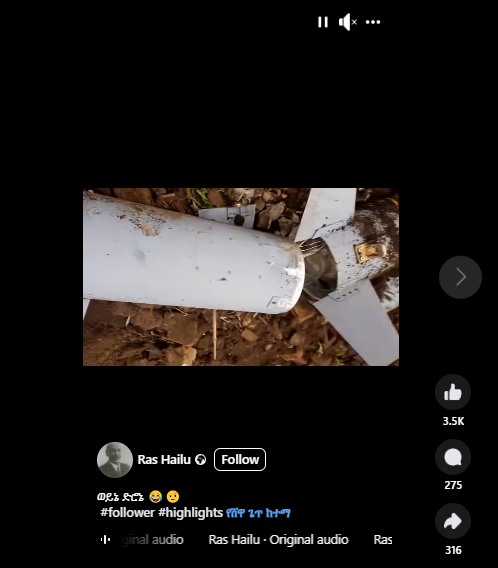
Recently, a video depicting a drone crash purportedly in the Amhara region amidst the conflict between the Ethiopian National Defense Force (ENDF) and the Fano military group caught the attention of many.


Screenshot of the false Facebook reel, taken on October 2024

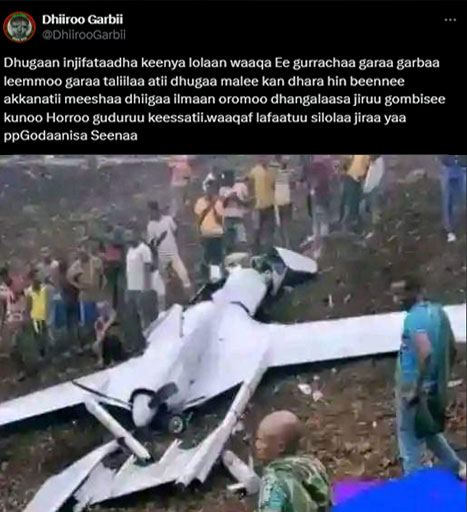
However, an online investigation has revealed the video was first shared in May 2024 claiming that the incident happened in Wellega.


Screenshot of an X post shared on May 2024

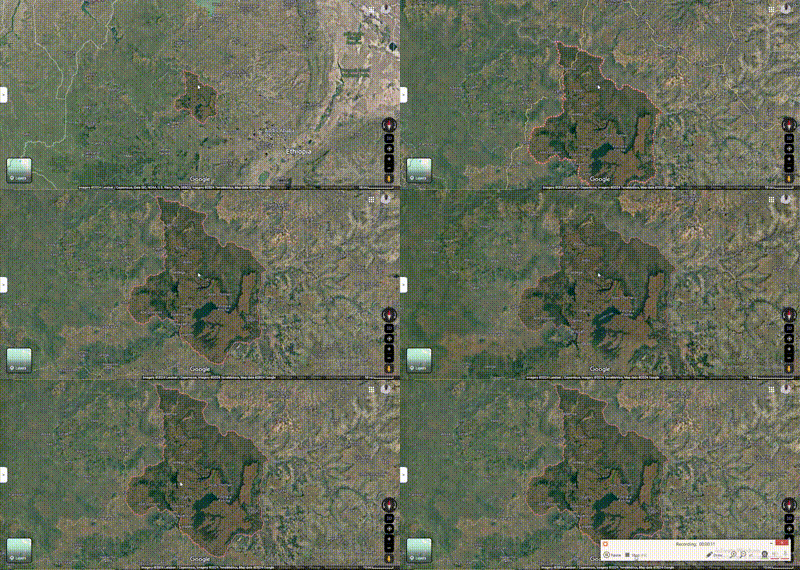
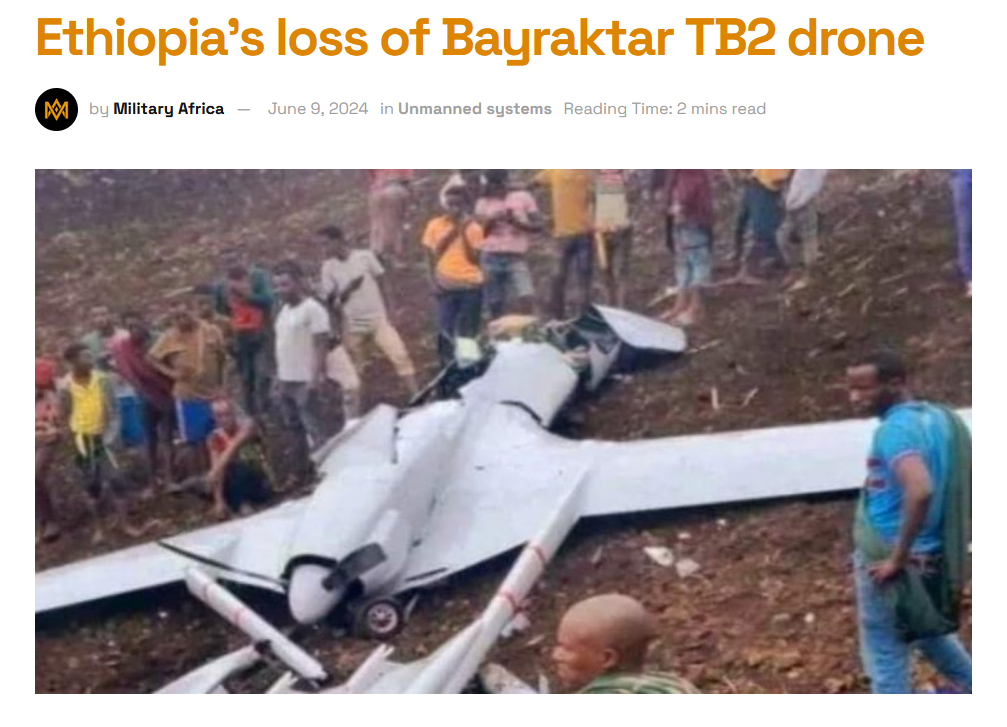
According to BBC NEWS Amharic, the incident was believed to have occurred in May 2024 on farmland in Horu Gudru Wellega, a zone in the Oromia Region of Ethiopia. The drone is confirmed to be the Bayraktar TB2 military-purpose drone, which was armed with two missiles when it crashed. The report shows that drones alone cost 5 to 6 million dollars, and mussels cost 60,000 to 100,000 dollars each.


Google map shows: the Horo Gudru Wellega zone in the Oromia region

The initial post, which quickly went viral, suggested that the drone crash was a consequence of the ongoing tensions in the Amhara region. The narrative painted a grim picture of the conflict, fueling emotions and opinions on social media. 

Upon closer examination, it was determined that the location of the drone crash was misattributed. The discrepancy between the actual location, Wellega, Oromia, and the misinformation linking it to the Amhara region highlights the dangers of misinformation in the digital age.

 
Screenshot: the image was found on the Military Africa website

Military Africa is an online resource for the defense sector that gives experts in the field access to crucial articles, data, and research on African procurement patterns and military/defense technologies.

According to alleged website testimonies, over the years, Military Africa has evolved from a conventional publisher to a trustworthy go-to resource that offers the defense sector complete end-to-end data support and guides strategic decision-makers and military leadership in Africa. Moreover, their publications show that the website mainly provides information on different technological military advancements, events related to defense/military, and other military news primarily in Africa.

Even though there are several claims that the government is using a military drone in the fight against Fano militants in the Amhara region, the video used to show a drone crash in the area is false.

For these reasons, HaqCheck rated the post as false.

Instances like these underscore the importance of critical thinking and fact-checking in the face of sensationalism or misleading content. In a landscape where information spreads rapidly and unchecked, it falls upon individuals to verify sources and question narratives that may be misleading or manipulative.

Recent Disinformation on X Regarding Ethiopian Refugees in Somalia

A memorandum of understanding signed between Ethiopia and Somaliland, a self-declared republic that is not internationally recognized, has heightened tensions between Ethiopia and Somalia. The memorandum of understanding was signed to secure Ethiopia’s access to the sea and to get recognition as a nation for Somaliland, which Somalia views as a violation of its sovereignty. This tension has been rising as Somalia asked for the withdrawal of Ethiopian troops from Somalia who were on a mission under the African Union Transion Mission In Somalia(ATMIS) and the deployment of Egyptian weapons and soldiers following its military agreement with Egypt.

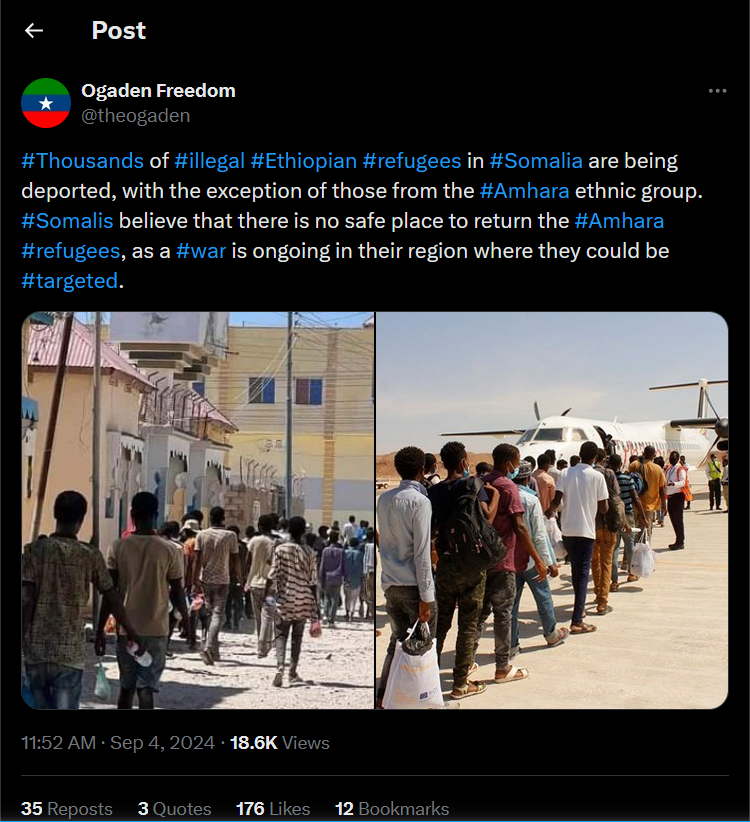
A recent post on X (formerly Twitter) has sparked controversy by claiming that thousands of Ethiopian illegal refugees, except the Amhara ethnic group, are being deported from Somalia. The post included two images purportedly supporting this claim.

Image

Upon investigation, it was revealed that the first image has been linked to reports from February 13, 2024, depicting refugees, especially from the Oromo ethnic group being deported from Bosaso, Puntland. As the report stated, the Bosaso officials have described the deportations as an essential response to the escalating violence in the city, a key port on Somalia’s coast. The operation targeted migrants accused of contributing to the local insecurity, with some detainees currently under investigation for possible connections to factions disrupting peace in the area.

Image

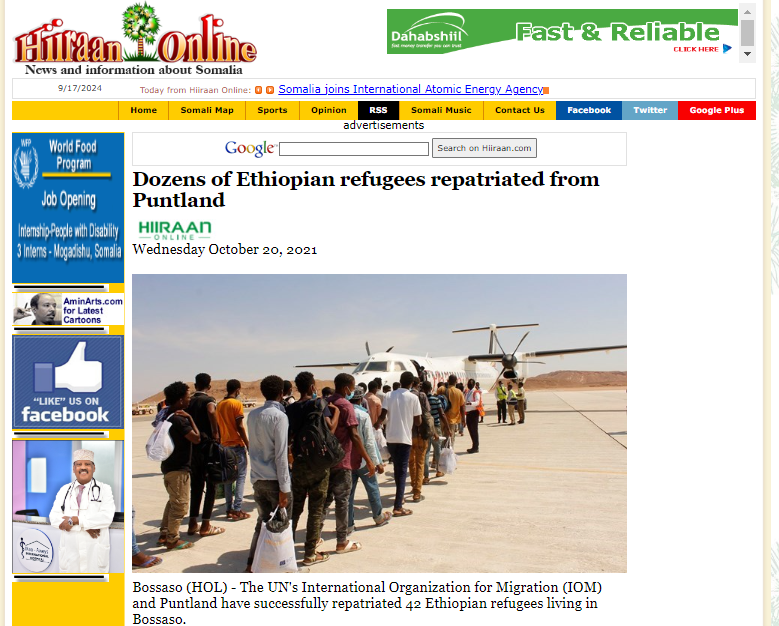
The second image, meanwhile, dates back to October 20, 2021, and shows Ethiopian refugees being repatriated from Puntland. It was stated that the repatriation was done by the Puntland administration in cooperation with the United Nations International Migration Agency (IOM).

The report also addressed that the refugees took advantage of an IOM’s Assisted Voluntary Return and Reintegration (AVRR) program to assist refugees with repatriation and were airlifted from Bosaso. Officials confirmed that they returned safely to Ethiopia.

Some of these refugees have been stranded in Bossaso for months and want to return home.

Image

The image, used to support the current narrative, is irrelevant to the ongoing tensions between Somalia and Ethiopia. Its timeline clearly shows that it predates the current situation by nearly three years.


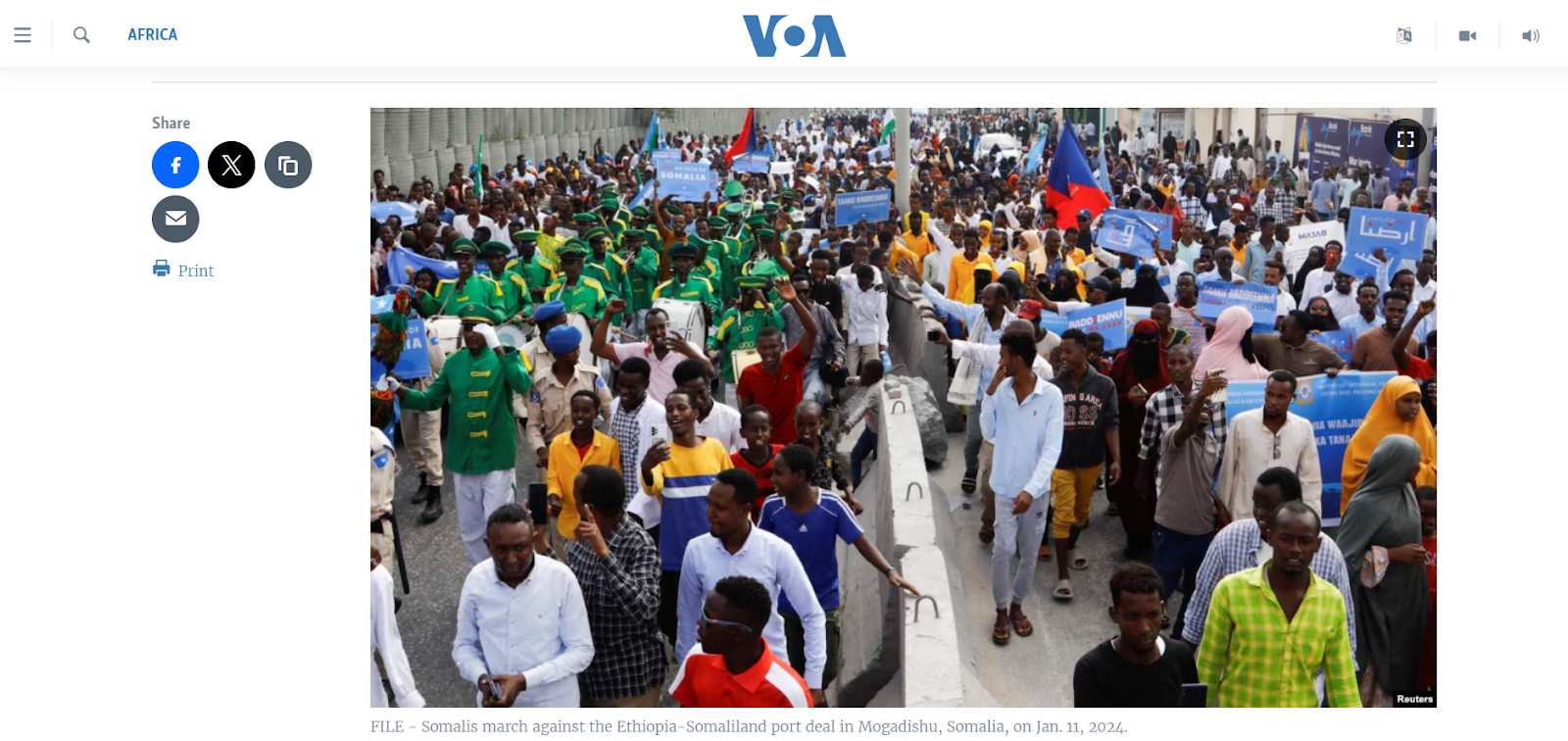
Another related post by the same X account with the exact similar caption and a different picture attached has also been found to be disinforming as the picture doesn’t show Ethiopians being deported from Somalia but rather the Somali people marching against the Ethiopia-Somaliland port deal in Mogadishu, Somalia, on Jan. 11, 2024.

Image     

Image                       

Such posts can exacerbate existing ethnic tensions and lead to misunderstandings about the situation on the ground. It highlights the necessity for careful verification of information before sharing.

Exit mobile version