May week three summary

Houses demolished for the construction of the new Ethiopian Palace

On May 19, 2023, a claim appeared on Twitter sharing two images that they show houses recently demolished for the construction of the new Ethiopian palace in Addis Ababa.

The Ethiopian government is building a new palace in the Yeka district of Addis Ababa for hundreds of billions of Birr.

There were recent social media reports claiming that people have been told to evacuate the area where the palace is being built within a few days.

HaqCheck inquired about the claim and looked into the images used as supportive.

However, one of the two pictures was old and had no connection with the construction of the new palace.

It was first published on Facebook on Feb 19, 2019, with a description that houses were being razed in the Legetafo Legedadi city administration, part of the then Finfinne Special Zone of the Oromia regional state.

The second picture was first published by Addis Standard on Jan 6, 2023, with a description that the picture shows a recently demolished house.

Therefore, the claim was rated Partly False.

Elon Musk launched the production of robot wives

HaqCheck came across many posts in the Ethiopian social media landscape claiming that the American billionaire Elon Musk has begun the production of robot wives and the product would soon be available in the market.

Images that show Elon Musk hugging and dancing with a human-like robot were circulated across social media platforms.

Tesla, an American technology company founded by Elon Musk announced in October last year that it already launched the production of humanoid robots with the purpose that they can help humans in their daily activities. The robots are two models named Optimus and Catanella.

It was in this context the claim came to life. However, the pictures circulated on social media to prove the claim were false and generated using artificial intelligence tools.

Recommendations

Recently, many artificial intelligence tools and software are emerging that can generate that seem very real.

HaqCheck recommends social media users look at images with caution and suspicion in case they are AI-generated.

We advise government institutions and other organizations to be accessible for information inquiries. They should provide timely briefings and updates.

Unfettered access to information is the key to combating disinformation. Access to information should be ensured by the government and relevant bodies.

Social media content creators should be responsible and avoid circulating false information.

Do these images show houses demolished for the construction of the new Ethiopian Palace?

On May 19, 2023, a claim appeared on Twitter sharing two images that they show houses recently demolished for the construction of the new Ethiopian palace in Addis Ababa.

The Twitter account has over nine thousand followers. The post was viewed more than eighteen thousand times and it was shared by 238 accounts across the platform.

However, HaqCheck inquired about the claim and confirmed that one of the two pictures was old and doesn’t support the claim. Thus, the claim was rated Partly False.

The Ethiopian government has embarked on the building of a new palace in the Yeka district of Addis Ababa. The palace project and other related facilities being built are dubbed by the government as ‘Chaka Project’.

The palace was first reported to cost 49 billion Birr, but later on, Prime Minister Abiy Ahmed (PhD) told the Parliament that his government was constructing the Chaka Project for hundreds of billions of Birr.

The Project to be sprawled on 503 hectares of land will comprise halls, artificial lakes, housing units, and road infrastructures.

It is supposed that thousands of people would be evacuated from the area where the project lays on. As part of it, a 20-kilometer long asphalt road was being built for 15 billion Birr.

Recent social media reports claim that people have been told to evacuate the area where the Chaka Project is being built within a few days.

On the other hand, the Addis Ababa city administration and the Oromia regional government have been engaged in house demolitions in Addis Ababa and surrounding areas in Oromia. The government says that the houses being demolished were illegal.

The administration of the newly established city of Sheger have recently demolished many illegal houses in the outskirts of Addis Ababa. The city administration claimed that it was knocking down illegally constructed houses.

Against this backdrop, a claim emerged on Twitter sharing two images that they show recently demolished houses for the construction of the new Ethiopian Palace.

However, HaqCheck investigated the claim and found out that one of the two pictures was old and has no connection with the construction of the new palace.

The first image used to support the claim was first published on Facebook on Feb 19, 2019 with a description that houses were being razed in the Legetafo Legedadi city administration, part of the then Finfinne Special Zone of the Oromia regional state.

The second picture in the Twitter post was first published by Addis Standard, a local media outlet, on Jan 6, 2023, along with a news article. The news outlet stated that the picture shows a recently demolished house and it was one of many images it received. But, Addis Standard didn’t give a further description of where was the house demolished. Therefore, HaqCheck rated the claim Partly False because one of the pictures used was old.

 May week two information disorder summary

The Ethiopian government released an AI-fabricated audio

HaqCheck was encountered with viral social media posts that claim that the phone call conversation between Mihret Wedajo and a Fano member released by the Ethiopian government to prove that Fano militias assassinated Girma Yeshitla was examined and debunked by an American organization called ‘Digi Forensic Experts’ as an AI constructed audio.

The claim emerged after the government blamed the Fano militia for murdering the Amhara Prosperity Party head Girma Yeshitla and released an audio that claimed to be a phone call conversation between the militia group’s leader Mihret Wedajo, and Belete Shegaw, a member of the militant group.

Screenshots of the result of the claimed audio forensic investigation circulated across social media platforms.

However, HaqCheck couldn’t find any organizational entity on the Internet registered as ‘Digi Forensic Experts’ and the alleged investigation of the audio released by the Ethiopian government couldn’t be found.

Additionally, the call number given on the screenshots belongs to a company named Digital Forensic Experts and the postal code, street address, and suite address belong to another film company. The text and the images are blurred.

Amharic is the second most-spoken language in the world

A claim was made on Twitter in the second week of May alleging that Amharic is the second most-spoken language in the world after Arabic.

HaqCheck used statistical data from Ethnologue, an annual statistics publication that is one of the top sources of world language statistics, to cross-check the claim.

Therefore, it was found out that Amharic is not the world’s second most-spoken language.

In terms of native speakers, Chinese Mandarin is the first, Spanish is the second, and English is the third.

Regarding total speakers, English is the first, Chinese Mandarin the second, and Hindi the third.

However, according to the publication, Amharic is the second most-spoken Semitic language next to Arabic although research say that Amharic is a mixture of Kushitic and Semitic languages.

Recommendations

 HaqCheck advises that social media users should be cautious of posts that may not be factual or truthful. Before reacting and sharing social media content with others, they should try to verify their authenticity.

To ensure that the public and media have timely briefings and updates, it is requested that public authorities and other bodies make information available and easily accessible.

It should be ensured that access to information is guaranteed. The absence of reliable information causes a much higher incidence of the dissemination of incorrect information.

We recommend that creators of social media content be responsible and avoid contributing to the dissemination of disinformation.

Is Amharic the second most-spoken language in the world?

HaqCheck came across a claim made on Twitter on May 9, 2023, that the Amharic language is the second most-spoken language in the world next to Arabic.

The Twitter post received many reactions and views on the platform. However, HaqCheck investigated the claim and rated it False.

There are organizations that publish periodic statistical data on languages and the number of speakers.

Ethnologue is an annual statistics publication and it is one of the top sources of world language statistics. The publication owned by a non-profit organization SIL International is considered as the main source of global language statistics by many institutions such as Encyclopedia, Wikipedia, and Oxford University.

Thus, HaqCheck used statistical data from Ethnologue to cross-check the claim.

Ethnologue ranks languages in terms of the number of native speakers and total (natives plus non-natives) speakers.

Accordingly, the most spoken language in the world in terms of total speakers is English. The language has 1.45 billion native and non-native speakers.

However, in terms of native speakers, Chinese Mandarin is by far the most-spoken language in the world with 939 million native speakers.

In terms of the number of total speakers, these are the ten most-spoken languages in the world: English, Chinese Mandarin, Hindi, Spanish, French, Arabic, Bengali, Russian, Portuguese, and Urdu. 

In terms of the number of native speakers, these are the ten most-spoken languages in the world: Chinese Mandarin, Spanish, English, Arabic, Hindi, Portuguese, Bengali, Russian, Japanese, and Lahnda.

For instance, Arabic is the fourth most spoken language in terms of native speakers and the seventh in terms of total speakers.

According to Ethnologue, Amharic which is the working language of the federal government of Ethiopia, has 32 million native speakers and 25 million non-native speakers.

In terms of native speakers, Amharic is the second most-spoken language in Ethiopia after the Afaan Oromo which has 37 million native speakers.

However, back to the claim, Amharic is not the second most-spoken language in the world.

According to researches,  Amharic was developed out of the mixture of Cushitic and Semitic languages.

Ethnologue categorizes Amharic as a Semitic language. Accordingly, Amharic is the second most-spoken Semitic language in the world after Arabic. Therefore, HaqCheck rated the claim False.

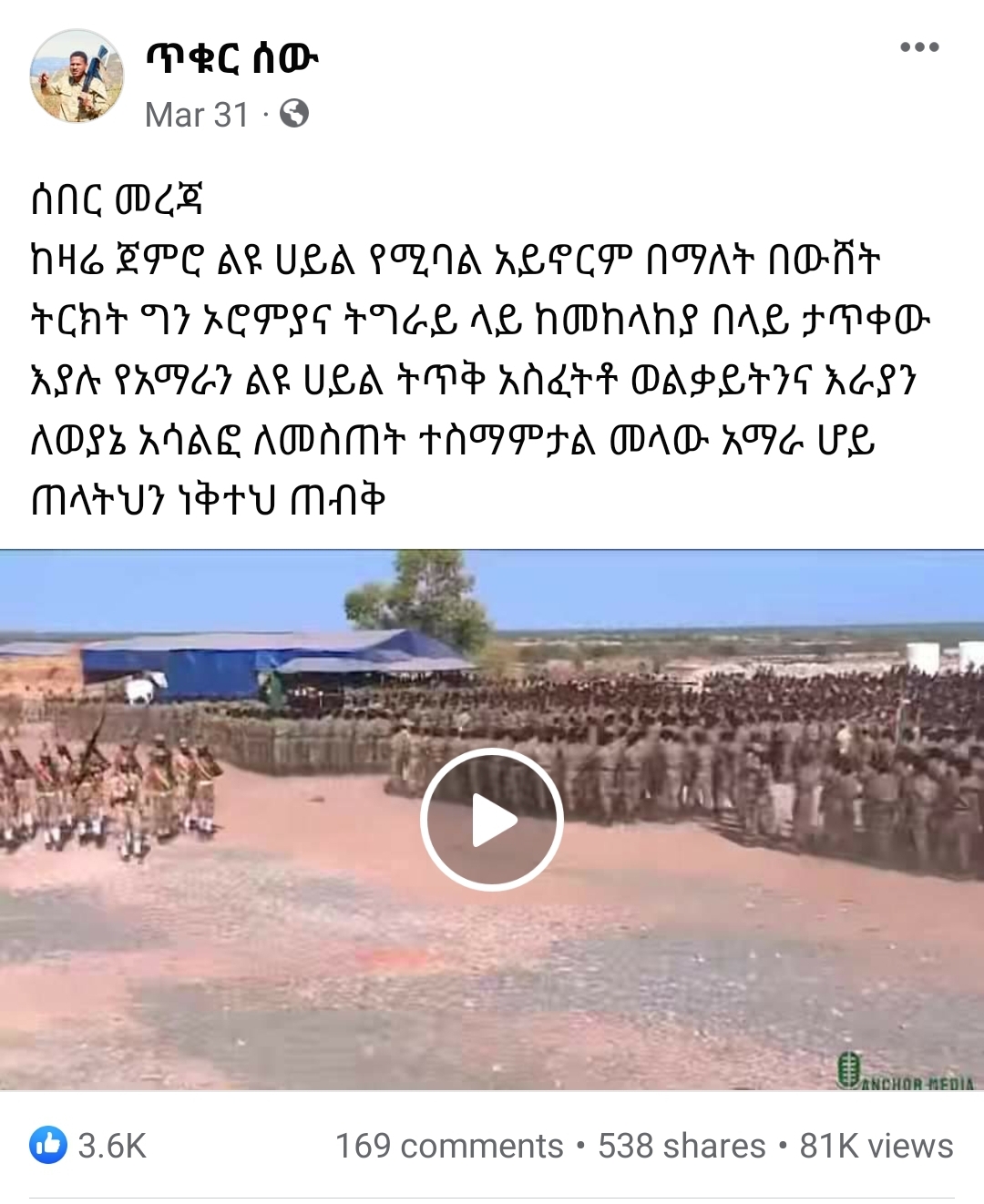
False: The image doesn’t show Ethiopian troops routed and captured by armed militias in the Amhara region

A Twitter account with more than six thousand followers shared an image on May 2, 2023, claiming that the Ethiopian defense soldiers were routed and captured by armed militias in Amhara region in a recent confrontation.

By the time this article was published, the post had nearly 15 thousand views, 135 retweets, and 360 reactions.

However, HaqCheck inspected the image and confirmed that it was old. It rendered the claim False.

On Apr 6, 2023, the Ethiopian federal government announced that it had decided that regional special police forces should be dissolved and integrated into the Ethiopian National Defence Forces, the Federal Police, or into regional polices.

Upon the announcement of the dissolution of regional paramilitary forces, tensions arose in the Amhara regional state. There have been armed clashes and public protests in the region opposing the federal government’s decision to disestablish regional special police forces.

On Mar 31, 2023, Teshome Toga, the National Rehabilitation Commissioner, said that the Commission conducted consultation across the country including in the Amhara region regarding the dissolution and reintegration of regional special police forces.

Amid the crisis, Girma Yeshitla, the head of the Amhara Prosperity Party was killed. The Ethiopian federal government and the Amhara regional government accused armed militias, commonly known as Fano, of assassinating the senior party official and vowed to take serious measures.

There were unconfirmed social media reports that the government deployed armed forces in the Amhara regional state and armed confrontations in various areas in the region.

Against this backdrop, a claim emerged on Twitter sharing an image with a claim that the alleged deployed Ethiopian troops were routed and captured by armed militias in Amhara region in recent confrontations.

HaqCheck looked into the image to investigate the claim. As a result, We found out that the image was old and has no connection with the claim.

The image was first published on the Internet since 2020 and shows Ethiopian troops marching into Tigray during the war between the Ethiopian government and the Tigray People’s Liberation Front (TPLF).

Therefore, HaqCheck rated the claim as False due to the usage of an inaccurate image.

Is the alleged Mihret Wodajo phone call recording audio released by the government AI-generated and Fake?

Social media platforms particularly Facebook recently surfaced with a claim that the phone call conversation between Mihret Wedajo and a Fano member released by the Ethiopian government to prove that Girma Yeshitla was assassinated by Fano militias was examined and debunked by an American organization called ‘Digi Forensic Experts’ as an AI constructed audio.

Background

Girma Yeshitla, the head of the Amhara Prosperity Party, a branch of the Ethiopian Prosperity Party and a ruling party in the Amhara regional state, was killed on Apr 27, 2023, in the Semen Shewa zone of the region.

The federal government accused ‘extremist forces’ of assassinating Girma Yeshitla. It said that these ‘extremist forces claimed to be fighting for the Ahmara people and in reality were trying to capture state power using force’.

The Amhara regional government blamed the Fano armed group, a group of armed militias in eastern parts of the Amhara regional state for the killing of Girma Yeshitila.

The militia group that was accused of murdering the senior party official is led by a person named Mihret Wedajo.

On Apr 29, 2023, state-affiliated media outlets such as the Addis Media Network came up with audio that claimed to be a phone call conversation between the militia group’s leader Mihret Wedajo, and Belete Shegaw, a member of the militant group. 

The government released the audio as evidence that Girma Yeshitla was killed by the Fano militia group.

The audio recording allegedly indicating Mihret Wedajo and another militant confirming they killed Girma Yeshitla had infested the Ethiopian social media landscape.

Days later, on May 7, 2023, a claim circulated across social media platforms that the audio released by the government as a conversation between Mihret Wedajo and Belete Shegaw was proven fabricated and fake.

The social media posts claimed that the audio was examined by an American technology company named Digi Forensic Experts and confirmed as the audio was generated using artificial intelligence.

The social media posts include screenshot papers allegedly taken from the forensic examiner organization. The claimed article was also published on a blog.

HaqCheck endeavored to cross-check the claim.

Is the organization ‘Digi Forensic Experts’ real?

HaqCheck couldn’t find any organizational entity on the Internet registered as ‘Digi Forensic Experts’.

But, there is a company called Digital Forensic Experts. The website of the company claims that it investigates the authenticity of audio and video files.

However, the alleged investigation of the audio released by the Ethiopian government was not on the website of Digital Forensic Experts.

We have searched the social media accounts of the company if the alleged article was published there. But, there was no social media handle with the same name as the company.

HaqCheck looked into the alleged (Digi Forensic Experts) organization’s address on the screenshots. The call number given belongs to a company named Digital Forensic Experts and the postal code, street address, and suite address belong to Kaufmann Media Group, a film company based in California, USA. Digital Forensic Experts and Kaufmann Media Group were founded by the same person named Sam Kaufmann.

Additionally, HaqCheck looked into the screenshot document and the images there. The text and the images are blurred.

[Image taken from the alleged forensic investigation by ‘Digi Forensic Experts’.]

The blurriness of the images and the texts clues that there is a probability that the images and the texts could be altered.

HaqCheck also found similar images on other sites to those used in the alleged forensic examination article.

These images are very similar to the pictures in the screenshots. These pictures were obtained published in a blog along with an article about an audio music forensic analysis.

HaqCheck approached the film production company, Digital Forensic Experts via email to inquire about the case. However, they did not yet respond to our inquest until this article was published.

May week one summary

A person attacked by Wahabis in Ethiopia

HaqCheck came across a Facebook post sharing a picture with a claim that a person shown in the image was attacked by Wahabis in Ethiopia. It also claimed that Wahabis attacked and killed Sufis and Muslims who followed other Islamic sects.

Wahhabi is an adherent of the Islamic reform movement (Wahhabism) founded by Muhammad ibn Abd al-Wahhab in the 18th century in Najd, Saudi Arabia. The adherents of Wahhabism usually call themselves Salafis.

HaqCheck investigated the image to determine the authenticity of the claim. However, the image was taken from an old publication and has no connection with the claim.

The image was first published on a website called Ketto, an online fundraising platform to support health treatment a year ago. The original image allegedly shows a 22 years old adult who had an accident.

Thus, the Facebook claim was rated False.

Altered image of Pastor Binyam Shitaye

An altered image was shared on TikTok claiming that Pastor Binyam Shitaye was seen praying with Muslims. The image shows a man wearing Jalabiya and a Muslim skullcap sitting among other prayers.

Pastor Binyam Shitaye was arrested in February this year in relation to the controversy within the Ethiopian Orthodox Tehahedo Church. The pastor, who is a Protestant and who was supporting the unity of the Orthodox Church, was then released on a 5000 Birr bail.

However, the image was altered. The original picture shows Ustaz Abubeker Ahmed, a known Muslim teacher, and activist who previously was arrested by the Ethiopian government.

The Ethiopian government carried out aerial bombardment in Amhara

An image was shared on Facebook showing the dead bodies of cattle with a claim that the animals were burned and dead due to an air strike the Ethiopian government recently carried out in Amhara regional state.

HaqCheck cross-checked the image and confirmed that the picture doesn’t support the claim.

The image was previously published on Facebook with a description that a fire accident in Gamo zone, southwestern Ethiopia caused damage to animals and property.

Ethiopian army routed in the Amhara region

An image emerged on Twitter supporting a viral claim that the Ethiopian army was being confronted by rebel armed groups in the Amhara regional state and forced to retreat disorderly.

The claim came amid an alleged conflict in the regional state between government armed forces and armed militia groups.

However, the image was old and was taken from a publication made three years ago. The original image shows Ethiopian army soldiers being deployed to battlefronts during the war between the Ethiopian government and the Tigray People’s Liberation Front (TPLF).

Recommendations

HaqCheck recommends social media users be skeptical of potentially false and misleading posts. They should seek to confirm the authenticity of social media content before reacting and sharing it with others.

Public offices and other institutions are urged to offer the public and the media timely briefings and updates.

The right to access information should be guaranteed. Lack of sufficing information greatly prompts the circulation of false information.

We advise social media content creators to be responsible and avoid being collaborators in disinformation dissemination.

April week one summary

Misleading debt-to-GDP ratio comparison by Mamo Mihretu

HaqCheck came across a misleading claim by Mamo Mihretu, the Governor of the National Bank of Ethiopia. He claimed that Ethiopia’s external debt stock is very small in comparison to other countries’ external debt stocks such as Kenya, Sudan, and South Africa.

Mamo claimed that while Ethiopia’s external debt is only 24% of its GDP, Kenya, South Africa, and Sudan respectively have debt amounting to 70%, 70%, and 181% of their GDP.

HaqCheck investigated the claim by the National Bank Governor if the figures were correct.

However, HaqCheck confirmed that the claim was false and the external debt-to-GDP comparison was misleading.

Accordingly, the external debt-to-GDP ratio of Kenya, South Africa, and Sudan is respectively 33.7%, 39.6%, and 150%.

Controversies over the dissolution of special police forces

One of the controversies during the week was regarding the dissolution of regional special police forces.

The federal government announced that the establishment of regional paramilitary forces, the special police force, is unconstitutional and regional special police forces should be disestablished.

There were claims that the federal government was planning to disarm and disband particularly the Amhara special police force.

Additionally, claims emerged that other regional special police forces would not be disarmed and the government targeted only the Amhara special force to dissolve.

This raised controversy on media platforms and instability in the Amhara regional state.

The federal government, later on, issued a statement and said that regional special police forces were not going to be disarmed and disbanded. It stated that all regional paramilitary forces were going to be reintegrated into the Ethiopian National Defence Forces, into the Federal Police, or regional police forces.

However, controversies and protests, especially in the Amhara regional state continued.

Recommendations

HaqCheck urges social media users to be skeptical of potentially misleading or false claims. They should seek more information from the source before reacting to claims.

We recommend public institutions and government offices offer the public and the media timely updates. The media should also enjoy the right to full access to information.

Social media content creators should be responsible and refrain from circulating unverified information.

National Bank Governor Mamo Mihretu’s Misleading Debt-to-GDP Ratio Comparison

Mamo Mihretu, the Governor of the Ethiopian National Bank, in an interview with Fana Broadcasting Corporation Television aired on April 1, 2023, claimed that Ethiopia’s external debt stock is very small in comparison to other countries’ external debt stocks such as Kenya, Sudan, and South Africa.

He said “Ethiopia’s external debt is 28 billion USD. This is only 24% of the [Ethiopian] GDP. This is not a large amount [in comparison with other countries]. For instance, Kenya’s debt amounts to 70% of its GDP, South Africa’s is 70% of its GDP, Sudan’s is 181% of its GDP, and USA’s is over 115% of GDP.”

HaqCheck investigated the claim by the central bank governor, Mamo Mihretu.

The debt-to-GDP ratio or percentage of debt (external, domestic, or total) to GDP is obtained by dividing the debt by the GDP.

Is Ethiopia’s external debt 24% of the GDP?

Yes, it is 24.6% of the GDP.

According to the World Bank, Ethiopia’s GDP at the end of June 2021 was 111.27 billion US dollars.

The annual report of the 2021/22 fiscal year by the National Bank of Ethiopia indicates that Ethiopia’s GDP stood at 5.9 trillion Birr.

The Ethiopian National Bank in its 2021/22 fiscal year report stated that Ethiopia’s external public debt reached USD 27.9 billion which is 24.6% of the GDP [around 113.5 billion USD].

Is Kenya’s external debt 70% of its GDP?

No. It is 33.7% of its GDP.

The World Bank said that Kenya’s GDP at the end of June 2021 was 110.35 billion US dollars.

At the end of June 2021, Kenya’s external public debt was 4,290.7 billion Kenyan Shillings (39 billion USD, calculated using the average exchange rate), which is 50% of the country’s total public debt, according to the Central Bank of Kenya.

Recent reports indicate Kenya’s external debt amounts to 37.87 billion US dollars.

As of June 2022, the external debt of Kenya was 33.7% of its GDP, according to the National Treasury of Kenya. The country’s total public debt is 8.6 trillion Kenyan Shillings which is 67.3% of the GDP.

Thus, Kenya’s external debt does not amount to 70% of its GDP. Rather it is 33.7% of the GDP.

Is South Africa’s external debt 70% of its GDP?

No, it is 39.28% to 40% of the GDP.

South Africa’s external debt stood at 164.6 billion US dollars as of December 2022, according to the South African Reserve Bank, the country’s central bank.

There is no official data from the country’s government on the size of the South Africa’s GDP.

The World Bank and the International Monetary Fund (IMF) present two different figures regarding the South African GDP.

The World Bank says South Africa’s GDP was 419.02 billion US dollars in 2021.

The IMF stated that the GDP of South Africa was 411.48 billion US dollars in 2022.

The average between the figures from the World Bank and the IMF is 415.25 billion US dollars.

Thus, the external debt-to-GDP ratio is 39.6% if we calculate it using the average figure.

If we use both figures of the South African GDP, the percentage of the country’s external debt to its GDP is between 39.28 and 40%.

Is Sudan’s external debt 181% of its GDP?

No, it is 150% of the GDP.

The government of Sudan has not published any latest data regarding the country’s size of GDP.

The World Bank said that Sudan’s GDP in 2021 was 34.33 billion US dollars. But the data is old and we can’t use it in calculating the currency external debt-to-GDP ratio.

The International Monetary Fund (IMF) stated that the GDP of Sudan as of 2022 was 42.76 billion US dollars.

Sudan’s external debt has reached 64.16 billion US dollars as of June 2022, according to the Central Bank of Sudan.

Therefore, Sudan’s external debt is 150% of its GDP.

The governor of the National Bank of Ethiopia, Mamo Mihretu, MISLEADINGLY compared the external public debt of Ethiopia to the total public debt (domestic+external) of Kenya, South Africa, and Sudan.

The Ethiopian economy and interest rate hikes by Western central banks: Explainer

PM Abiy Ahmed (PhD) told the parliament on March 28, 2023, that the rising interest rate in the US has had devastating effects on the Ethiopian economy.

Ethiopia has a lot of debt owed to China and international multilateral lenders. Reports indicate that the country has 56 billion dollars in total debt to be paid. Out of the 56 billion, 28 billion were borrowed from external lenders.

The US and international financial institutions such as the World Bank and IMF pledged to provide Ethiopia with billions of dollars for the Homegrown Economic Reform’ initiated by PM Abiy to liberalise and privatise the Ethiopian economy.

The IMF and World Bank promised to give Ethiopia billions of dollars for the Homegrown Economic Reform.

Later on, these pledges were suspended. The World Bank and IMF suspended the disbursement of the pledged billions of dollars after Ethiopia began filling the Great Ethiopian Renaissance Dam (GERD) in June 2020 and due to the armed conflict in northern Ethiopia.

Ethiopia has since been barred from accessing financial provision from these multilateral financial institutions.

The US government halted hundreds of millions of dollars of budgetary support to Ethiopia in 2020 due to the GERD crisis. Additionally, Ethiopia has been excluded from the African Growth and Opportunity Act (AGOA) trade preference programme because of the war with the TPLF.

Since the wake of the COVID-19 lockdown, countries across the globe have been hit with inflation, mainly due to a shortage of supply (production) because people were off work.

The central banks of many countries have been increasing interest rates to reduce the circulation of money in the market so that inflation could be lowered. The US central bank, the Federal Reserve, has increased interest rates many times since 2022 to bring down inflation to 2%.

In 2022 alone, the US Federal Reserve increased interest rates seven times, raising them from 0.25% in March to 4.50% in December. On March 22, 2023, the Fed raised the interest rate to 4.9%, which is the highest since 2007.

Two weeks ago, the European Central Bank increased the interest rate benchmark to 3%, which is the highest since 2008.

The United Kingdom’s central bank, the Bank of England, raised the interest rate on March 23, 2023, to 4.25%.

Interest rates, particularly in the US and Europe, were very low before the outbreak of the COVID-19 pandemic. Money was cheap and accessible for borrowers.

The high interest rates in the US and Europe mean that countries like Ethiopia have to borrow dollars or other hard currencies at high interest rates to pay back their debts.

The Ethiopian economy has suffered from a shortage of hard currency. This resulted in sweeping inflation and an economic crisis. The government is desperately seeking foreign loans and financial support.

In addition to getting finances, the Ethiopian government has to deal with the staggering amount of matured debt in the country owed to China and international multilateral creditors.

The Ethiopian government has been asking multilateral and bilateral lenders to restructure the country’s debt. Ethiopia requested the G20 countries and the Paris Club, a group of major creditor countries, make debt adjustments.

Upon Ethiopia’s request, in September 2021, twelve member countries of the G20 and the Paris Club formed a committee co-chaired by China and France to discuss the country’s debt treatment.

Ethiopian Prime Minister Abiy paid a visit to France on Feb 8, 2023, and discussed with Emmanuel Macron, French President about the restructuring of debt.

On Feb 20, 2023, an Ethiopian government delegation that includes Finance Minister Ahmed Shide, Mamo Mihretu, Governor of National Bank of Ethiopia, Lelise Nami, Ethiopian Investment Commissioner, Eyob Tekalegn (PhD), Finance State Minister arrived in China to discuss about debt restructuring, among other things, with Chinese officials.

Since the interest rates are high, it is difficult for developing countries, especially those with huge amounts of matured debt, to easily borrow dollars and pay their debts. Money is only available at high interest rates.

Exit mobile version